Aquamarine
The blue variety of beryl, harder than quartz and well suited to everyday rings.
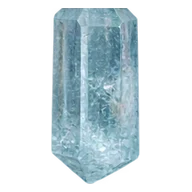
| Mineral / material | Beryl (blue to green-blue variety) |
|---|---|
| Chemical formula | Be₃Al₂Si₆O₁₈ |
| Mohs hardness | 7.5–8 |
| Crystal system | Hexagonal |
| Luster | Vitreous |
| Typical sources | Brazil, Madagascar, Nigeria, Mozambique, Pakistan |
What gives aquamarine its color?
Iron in the beryl structure gives the blue to green-blue color.
Treatments and lookalikes
- Heating to remove green or yellow tones is common and permanent.
Often confused with or imitated by: Blue topaz, Synthetic spinel, Blue glass.
How to tell real aquamarine from imitations
- Aquamarine tends to be pale to medium blue; very saturated "Swiss" or "London" blue is usually treated topaz.
- Raw crystals are six-sided prisms.
- Separating aquamarine from blue topaz or glass reliably needs refractive index or specific gravity tests at a lab.
These signs can suggest an answer but rarely prove it. For a valuable piece, ask the seller for treatment disclosure or have it checked by an accredited gem laboratory. Never scratch-test finished jewelry or a stone you do not own.
How to wear and clean aquamarine
- Daily wearEveryday wear
- WaterWarm soapy water OK
- SunlightColor stable in normal light
- Ultrasonic cleanerUsually safe (not if fractured or dyed)
- Skip ultrasonic and steam cleaning if the stone has fractures or liquid inclusions.
Best suited to: pendants and necklaces, rings, earrings, bracelets, display specimens. Compare it with other stones in the care chart, or use the jewelry finder.
Sources
- GIA. Aquamarine.
- GIA. Aquamarine Care and Cleaning.
- Mindat. Aquamarine.
Crystal Field Guide covers mineralogy, identification and care. We make no claims that any stone affects health, mood or fortune. Home checks can only suggest an answer; for certainty about a valuable stone, ask an accredited gem lab.
Aquamarine jewelry on Amazon
Dainty Infinity Birthstone Necklaces Sterling Silver Pendant
FANCIME
Check price on AmazonBirthstone Necklace for Women, Silver Chain Oval Gemstone Pendant
Check price on Amazon