Black Tourmaline
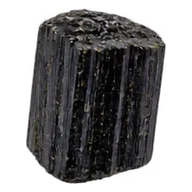
The common black, iron-rich member of the tourmaline group, recognised by its striated, rounded-triangular crystals.
| Mineral / material | Schorl (iron-rich tourmaline) |
|---|---|
| Chemical formula | NaFe²⁺₃Al₆(Si₆O₁₈)(BO₃)₃(OH)₃(OH) |
| Mohs hardness | 7–7.5 |
| Crystal system | Trigonal (long prisms with a rounded triangular cross-section) |
| Luster | Vitreous |
| Typical sources | Brazil, Pakistan, Namibia, Madagascar, Maine and California (USA) |
| Also called | Schorl |
What gives black tourmaline its color?
A high iron content absorbs nearly all visible light, so schorl looks opaque black.
Treatments and lookalikes
- Usually untreated.
Often confused with or imitated by: Obsidian, Black onyx, Hematite, Black glass.
How to tell real black tourmaline from imitations
- Raw crystals have deep lengthwise grooves (striations) and a rounded three-sided cross-section.
- Tourmaline is harder than obsidian and does not show conchoidal glassy breaks across the whole piece.
- Very uniform round black beads are often onyx or glass rather than tourmaline.
These signs can suggest an answer but rarely prove it. For a valuable piece, ask the seller for treatment disclosure or have it checked by an accredited gem laboratory. Never scratch-test finished jewelry or a stone you do not own.
How to wear and clean black tourmaline
- Daily wearEveryday wear
- WaterWarm soapy water OK
- SunlightColor stable in normal light
- Ultrasonic cleanerAvoid
- Raw crystals can split across the prism if dropped.
- GIA advises against ultrasonic and steam cleaning for tourmaline.
Best suited to: bracelets, pendants and necklaces, display specimens. Compare it with other stones in the care chart, or use the jewelry finder.
Sources
- GIA. Tourmaline.
- GIA. Tourmaline Care and Cleaning.
- Mindat. Schorl.
- Geology.com. Tourmaline.
Crystal Field Guide covers mineralogy, identification and care. We make no claims that any stone affects health, mood or fortune. Home checks can only suggest an answer; for certainty about a valuable stone, ask an accredited gem lab.
Black Tourmaline jewelry on Amazon
Handmade Natural Stone Bead Stretch Bracelet
MASSIVE BEADS
Check price on AmazonHandmade Gemstone Bead Stretch Bracelet
AD Beads
Check price on AmazonCrystal Beaded Bracelets for Women
Check price on Amazon