Lepidolite
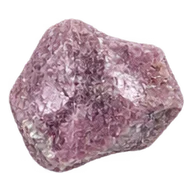
A soft lilac lithium mica that glitters with flaky layers; best for display or gently worn pieces.
| Mineral / material | Lithium-bearing mica (lepidolite series) |
|---|---|
| Chemical formula | K(Li,Al)₃(Al,Si,Rb)₄O₁₀(F,OH)₂ |
| Mohs hardness | 2.5–3 |
| Crystal system | Monoclinic (flaky sheets) |
| Luster | Pearly to vitreous |
| Typical sources | Brazil, Madagascar, Zimbabwe, California and Maine (USA) |
What gives lepidolite its color?
Traces of manganese give the lilac to pink color.
Treatments and lookalikes
- Tumbled stones and beads are often a rock of lepidolite mixed with quartz and other minerals.
Often confused with or imitated by: Dyed stones, Purple glass.
How to tell real lepidolite from imitations
- Sparkling, flaky mica layers are visible on raw pieces and often under a loupe on polished ones.
- A fingernail-soft spot or flakes peeling at the edges on raw pieces are typical of mica.
- Beads with strong, uniform purple and no sparkle may be dyed or glass.
These signs can suggest an answer but rarely prove it. For a valuable piece, ask the seller for treatment disclosure or have it checked by an accredited gem laboratory. Never scratch-test finished jewelry or a stone you do not own.
How to wear and clean lepidolite
- Daily wearOccasional wear / display
- WaterQuick wipe, never soak
- SunlightColor stable in normal light
- Ultrasonic cleanerAvoid
- Very soft: keep it away from other stones and wipe it clean instead of scrubbing.
Best suited to: bracelets, pendants and necklaces, display specimens. Compare it with other stones in the care chart, or use the jewelry finder.
Sources
- Mindat. Lepidolite.
- Geology.com. Lepidolite.
Crystal Field Guide covers mineralogy, identification and care. We make no claims that any stone affects health, mood or fortune. Home checks can only suggest an answer; for certainty about a valuable stone, ask an accredited gem lab.
Lepidolite jewelry on Amazon
Natural Gemstone Beaded Bracelets for Women, Set of 4
Check price on AmazonLepidolite Crystal Bracelet for Women Men's Gifts
Amazing Gemstone
Check price on AmazonPurple Lepidolite Bracelet, 12mm Beads
Check price on Amazon