Labradorite
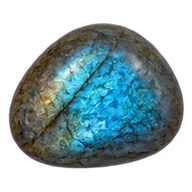
Gray plagioclase feldspar that flashes blue, green and gold at certain angles; handle with some care.
| Mineral / material | Plagioclase feldspar (sodium-calcium) |
|---|---|
| Chemical formula | (Ca,Na)(Al,Si)₄O₈ |
| Mohs hardness | 6–6.5 |
| Crystal system | Triclinic |
| Luster | Vitreous; flashes of color (labradorescence) |
| Typical sources | Canada (Labrador), Finland, Madagascar, Norway |
What gives labradorite its color?
Light interference in microscopic layers inside the feldspar produces flashes of blue, green, gold and sometimes the full spectrum.
Treatments and lookalikes
- Usually untreated.
Often confused with or imitated by: Glass with a backing, Synthetic opal-like plastics.
How to tell real labradorite from imitations
- The flash appears only at certain angles and switches off as you turn the stone.
- Natural labradorite shows dark gray body color, lamellar lines and often small black inclusions.
- A flash that looks the same from every angle suggests a coating or a man-made material.
These signs can suggest an answer but rarely prove it. For a valuable piece, ask the seller for treatment disclosure or have it checked by an accredited gem laboratory. Never scratch-test finished jewelry or a stone you do not own.
How to wear and clean labradorite
- Daily wearWear with care
- WaterWarm soapy water OK
- SunlightColor stable in normal light
- Ultrasonic cleanerAvoid
- Feldspar cleavage makes it vulnerable to knocks; choose protective settings for rings.
Best suited to: pendants and necklaces, earrings, bracelets, rings, display specimens. Compare it with other stones in the care chart, or use the jewelry finder.
Sources
- Mindat. Labradorite.
- Geology.com. Labradorite.
Crystal Field Guide covers mineralogy, identification and care. We make no claims that any stone affects health, mood or fortune. Home checks can only suggest an answer; for certainty about a valuable stone, ask an accredited gem lab.
Labradorite jewelry on Amazon
Labradorite Pendant Necklace for Unisex Natural Crystal Wire Wrap for Gifts
Check price on AmazonMulti Shapes Gemstone Silver Overlay Handmade Pendant Necklace
Sterling Silver Jewelry
Check price on Amazon