How to Spot Dyed Crystals and Stones
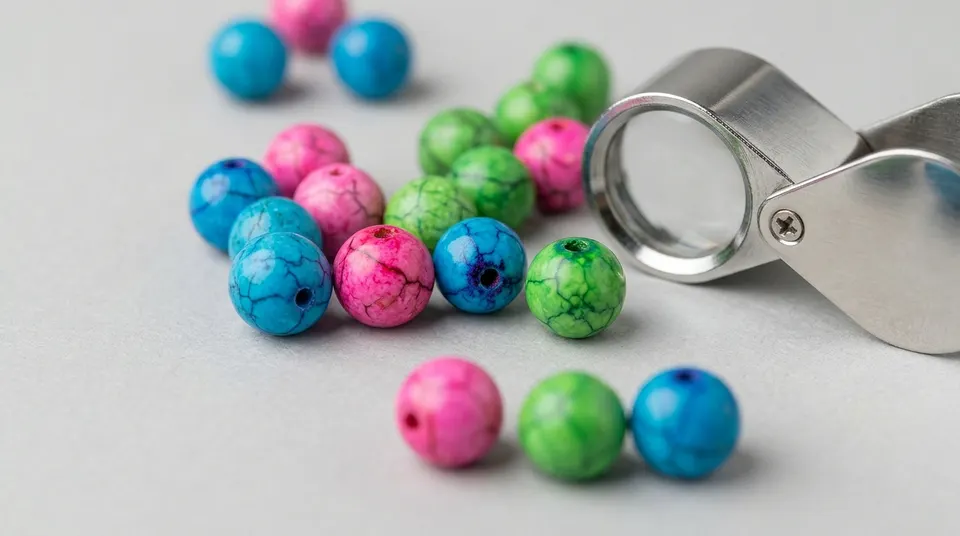
Quick Answer
To spot a dyed crystal, look for color that is darker along cracks, pits, bead drill holes and the surface than inside the stone, and for hues that do not occur in nature (neon blue or pink agate). Check whether the seller discloses dyeing. A 10x loupe catches most dyed agate and quartz, but dyed jade, coral and turquoise can be undetectable without a gem lab.
On this page
Key Takeaways
- Dye only gets into stones that are porous (agate, turquoise, howlite) or have cracks that reach the surface (quartz); it tends to pool in those cracks, pits and drill holes.
- A hue that does not occur in nature, such as neon-bright agate, is proof of dye on its own, according to GIA.
- Dyed howlite and magnesite are often sold as turquoise; a lab separates them with infrared spectroscopy.
- Some dye cannot be seen with a loupe at all, including many colors of dyed jade, so only a gem lab report gives certainty.
- Under the FTC Jewelry Guides, sellers must disclose a treatment that is not permanent, needs special care or significantly affects value.
What Does “Dyed” Mean for a Crystal or Stone?
GIA defines dyeing as introducing a colored substance into gem materials that have either a porous structure, such as agate or turquoise, or surface-reaching fractures, such as quartz or corundum, to change their color [1]. That definition explains almost everything about how to spot it: dye needs a way in, so it collects wherever the stone is open.
The practice is old. GIA notes that dyeing has been used since ancient times on coral, turquoise, lapis lazuli, howlite, nephrite jade, chalcedony, quartz, emerald and ruby, and that the fractures that let dye in are sometimes created on purpose by heating the stone [2]. Heating clear quartz until it crackles and then soaking it in color is one way bright "crackle quartz" beads are made.
Dyeing is not the same as fake. A dyed agate bead is still agate, and a dyed howlite bead is still howlite. The problem is not the dye itself but a dyed stone sold as a different, untreated stone. Two other treatments are easy to confuse with dye:
- Surface coating puts a colored or metallic layer on the outside. GIA says coatings show up under magnification as scratches, worn spots at facet edges and tiny trapped bubbles.
- Heat treatment changes color through the whole stone without adding anything. Our guide on whether your citrine is real covers heated amethyst sold as citrine.
Which Crystals and Stones Are Most Often Dyed?
Porous, light-colored, inexpensive materials are the usual candidates, because they take dye easily and can be made to look like costlier stones. The table summarizes what GIA reports for common materials.
| Stone | Often dyed to look like | Where dye shows | How reliably it is detected (GIA) |
|---|---|---|---|
| Agate / chalcedony | Deep blue, green, pink or black stone | Uneven absorption between bands; hues not found in nature | Usually detectable; an unnatural hue proves dye |
| Quartz (incl. crackled clear quartz) | Colored quartz, other bright gems | Color lines inside surface-reaching cracks | Usually detectable with magnification |
| Howlite and magnesite | Turquoise | Color pooled in fine veins and drill holes | Lab infrared spectra separate them from turquoise |
| Turquoise | Deeper, more even blue | Porous areas | Not always detectable |
| Lapis lazuli | Deeper blue | Uneven color in porous areas | Often detectable with magnification |
| Jade (jadeite and nephrite) | Greener or other colors | Grain boundaries | Green dye usually detectable with a spectroscope; lavender, black, brown and yellow may not be detectable at all |
| Coral | More even red or pink | Pores | Not always detectable |
| Pearls (gray, black, "golden") | Natural dark or golden color | Often invisible | Needs EDXRF, UV-Vis-NIR or Raman testing |
Sources: GIA's treatment chart in Gems & Gemology and its treatment overview; the howlite row is from GIA's 2024 Gems & Gemology review of infrared spectroscopy.
Howlite deserves a special mention. It is a white stone with gray or black veins, and GIA writes that turquoise is often imitated by dyeing common and inexpensive minerals such as howlite or magnesite, and that FTIR spectra clearly distinguish turquoise from these imitations [3]. Undyed, it is a nice stone in its own right; see our howlite profile. Lapis lazuli is another frequent case, so our lapis lazuli profile lists what natural color and pyrite flecks look like. Natural pale banding, like the soft blue of blue lace agate, is a useful reference for what undyed agate color usually looks like.
How Can You Tell If a Stone Is Dyed at Home?
The single most useful tool is a 10x jeweler's loupe and a white light. GIA says that in most gem materials dyeing is readily detectable with magnification, sometimes combined with diffused light, and that concentrations of color often sit along surface-reaching fractures or within porous areas [1].
Work through these checks on a stone or bead you own or are allowed to handle:
- Look at the drill holes. On beads, a ring of darker color around the hole, or color that bleeds into the hole, is a common sign that dye soaked in from the opening.
- Follow the cracks. Under 10x, dyed quartz and agate often show thin, darker lines of color running exactly along fractures, while the solid areas between them are paler.
- Compare the surface with the inside. Chips, worn edges or the inside of a drill hole may reveal a paler core under a darker skin.
- Ask whether the color exists in nature. GIA notes that some gems are dyed to hues that do not exist in nature, which alone proves dye, with agate as the example. Neon-bright agate colors are the typical cases to question.
- Check how uniform the strand is. Natural stones vary from bead to bead. A full strand of identical, saturated color in a material that is normally pale is a reason to look more closely, not proof.
- Watch for color transfer. GIA notes that many dyes can be removed by contact with a solvent such as alcohol or acetone. If a cotton pad picks up color during cleaning, the stone is very likely dyed. The reverse does not hold: a clean pad proves nothing, and solvents can strip the dye, so do not use them as a test on jewelry or on a stone that is not yours.
Never scratch-test or file a finished piece of jewelry or a seller's stone to "check" it. It damages the piece and does not detect dye anyway.
When Can You Not Tell Without a Gem Lab?
Home checks find the obvious cases. They cannot clear a stone. GIA's treatment chart is direct about the limits: in structurally porous materials such as coral, jade and turquoise, dyeing may not always be detectable; gray to black or "golden" pearls may need EDXRF, UV-Vis-NIR or Raman spectrometry; and while dyed green jadeite can usually be caught with a handheld spectroscope, most other colors of dyed jadeite, such as lavender, black, brown and yellow, may not be detectable at all [1].
For turquoise, the same applies to imitations: dyed howlite or magnesite can look convincing on a strand, and the clean separation GIA describes comes from FTIR spectra, a lab instrument. GIA lists turquoise at 5 to 6 on the Mohs scale [4], which is one reason a scratch test is both damaging and unhelpful here.
If the stone is valuable or the price depends on it being untreated, ask for a report from an independent gem lab such as GIA before you buy, or make the sale conditional on one. A lab uses magnification, spectroscopy and chemical analysis that no home kit replaces.
What Must Sellers Tell You About Dyed Stones?
In the US, the FTC Jewelry Guides say it is unfair or deceptive to fail to disclose that a gemstone has been treated if the treatment is not permanent, if it creates special care requirements, or if it has a significant effect on the stone's value [5]. For items sold online or by catalog, the disclosure should appear in the product description. Many dyes meet at least one of those tests, because GIA notes that some dyes fade in sunlight and that larger fractures can let dye leak out.
GIA goes further in its own guidance, stating that anyone selling a gem, including consumer-to-consumer sales, should disclose the treatment [2]. In practice, look for words such as "dyed," "color enhanced," "treated" or "stabilized" in a listing. Words like "natural" or "genuine" on their own do not tell you whether the color was added.
Good questions to ask a seller:
- Is the color natural, or is the stone dyed, heated, coated or stabilized?
- Is the treatment stable, and does it need special care?
- If this is sold as turquoise, is it turquoise, or a dyed stone such as howlite or magnesite?
- Will you accept a return if an independent lab finds an undisclosed treatment?
How Should You Care for Dyed Stones?
Because dye sits in pores and cracks, care is about keeping it there. GIA advises keeping dyed gems away from chemicals such as acetone or alcohol and out of prolonged sunlight, since some dyes are unstable under ultraviolet light and can fade over time [2].
Practical care for dyed beads and stones:
- Clean with mild soap and lukewarm water, then pat dry. Skip alcohol wipes, nail polish remover and perfume sprayed directly on the stone.
- Avoid long soaks. GIA notes that dye in larger fractures can leak out under a variety of conditions, and a long soak is an easy one to avoid. On stretch bracelets it also weakens the cord.
- Keep it out of strong sun on windowsills and car dashboards, where faded color does not come back.
- Store pieces apart so softer dyed beads do not rub against harder stones; a quartz bracelet can scratch a turquoise or howlite one.
Our care chart puts water, sunlight and cleaning notes for each stone side by side, and the jewelry finder can point you to stones that suit daily wear if you would rather avoid treated material altogether.
Useful for this guide
Loupes 10x Glass Jeweler Loupe Loop Eye Magnifier Magnifying Magnifier Metal Body Silver
Check price on AmazonJewelers Loupe Magnifier 10X Triplet Loupe
Check price on Amazon3 Pcs Jewelers Loupe Eye 10X 20X 30X Hand Lens Set,Silver,Triplet Style
Check price on Amazon
Frequently Asked Questions
Is dyed agate still real agate?
Yes. Dyed agate is natural agate whose color was changed by dye soaked into its porous structure. It is a genuine stone with an added color, which is why sellers should disclose the treatment. GIA notes that some agate is dyed to hues that do not exist in nature, which alone proves dye, so a neon-bright color in agate is a strong clue.
Does dyed howlite fade or rub off?
It can. GIA notes that many dyes can be removed by solvents such as alcohol or acetone and that some fade with prolonged ultraviolet exposure. Dyed howlite beads sold as turquoise may lighten over time, especially near drill holes and worn surfaces. Keep them away from solvents, perfume and strong sun.
Can a jeweler tell if my stone is dyed?
Often, yes. GIA says a qualified gemologist can detect dyed gems in most cases, usually with magnification. Exceptions include porous jade, coral and turquoise, where dye may not always be detectable, and some colors of dyed jadeite that cannot currently be detected at all. For a written answer, ask for an independent gem lab report.
Is dyed clear quartz the same as colored quartz like amethyst?
No. Amethyst gets its purple color inside the crystal itself, while dyed quartz is usually clear quartz that was crackled by heating and soaked in dye, so the color sits in the cracks. Under a loupe, dyed crackle quartz shows a web of colored lines. Our guide on how to tell if amethyst is real covers natural purple quartz in detail.
Our Take
We think dyed stones get an unfairly bad reputation. A dyed agate or howlite bracelet can be an attractive, inexpensive piece, as long as it is sold as what it is. The real issue is disclosure: in our view, a listing that says "natural turquoise" for a blue stone that costs far less than turquoise should send you to the questions above, not to checkout. Use a loupe for the easy cases, trust drill holes and cracks more than marketing words, and accept that some dye is beyond any home check. If the price depends on the color being natural, we would treat a gem lab report as part of the purchase, not an extra.
Sources
- Chart of Commercially Available Gem Treatments. GIA (Gems & Gemology).
- An Introduction to Gem Treatments. GIA.
- Infrared Spectroscopy and Its Use in Gemology. GIA (Gems & Gemology).
- Turquoise Description. GIA.
- 16 CFR § 23.24 - Disclosure of treatments to gemstones. Legal Information Institute, Cornell Law School.
Crystal Field Guide covers mineralogy, identification and care. We make no claims that any stone affects health, mood or fortune. Home checks can only suggest an answer; for certainty about a valuable stone, ask an accredited gem lab. Spotted an error? Tell us.
More Crystal Guides
How to Tell If Amethyst Is Real: Natural, Synthetic and Glass
How to tell real amethyst from synthetic quartz and glass: color zoning, bubbles, refractive index, heat treatment, and when only a gem lab can be sure.
Is Your Citrine Real? Natural Citrine vs Heat-Treated Amethyst
How to tell natural citrine from heat-treated amethyst: color, zoning, dichroism and what a gem lab checks, plus why most citrine on the market is heated.
Rose Quartz vs Pink Glass vs Dyed Quartz: How to Tell
How to tell natural rose quartz from pink glass and dyed quartz: color, clarity, gas bubbles, dye-filled cracks, hardness, FTC disclosure rules and lab tests.
Which Crystals Fade in Sunlight? A Stone-by-Stone Guide
Which crystals fade in sunlight: what GIA says about amethyst, citrine, kunzite, topaz and rose quartz, why dyed stones fade, and how to display stones safely.
How to Clean Crystal Jewelry Without Damaging It
Clean crystal jewelry with warm water, mild soap and a soft brush. Which stones must skip ultrasonic, steam and chemical cleaners, and why GIA says so.
How to Store Crystal Jewelry and Stones Without Scratches
Store crystal jewelry by hardness: a pouch or slot per piece, soft stones and pearls kept apart, away from strong light, heat and plastic bags. Stone by stone.