Is Your Citrine Real? Natural Citrine vs Heat-Treated Amethyst
Quick Answer
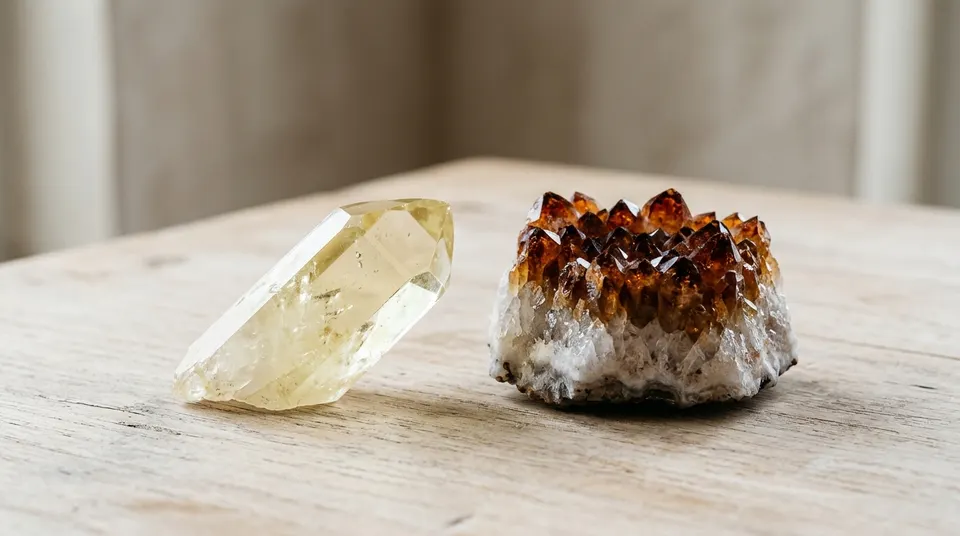
Your citrine is almost certainly real quartz, but it is probably heat-treated amethyst rather than natural citrine. GIA says most citrine on the market is heated amethyst. Clues to heating are strong orange or reddish-brown color and color concentrated at crystal tips. Natural citrine is usually pale, evenly colored and weakly dichroic. These signs only suggest an answer; a gem lab is needed for certainty.
On this page
- What Is Citrine, and Why Is Most of It Heated Amethyst?
- Is Heat-Treated Citrine Fake?
- How Can You Tell Natural Citrine from Heat-Treated Amethyst?
- What Does a Gem Lab Check, and Can It Always Tell?
- Where Does Natural Citrine Come From?
- How Should You Buy, Wear and Care for Citrine?
- Frequently Asked Questions
- Our Take
- Sources
Key Takeaways
- GIA states that most citrine on the market is the result of heat treatment of amethyst; natural citrine is rare.
- Heated amethyst is genuine quartz with the same hardness (Mohs 7) and refractive index as natural citrine, so simple tests cannot separate them.
- Deep orange or reddish-brown color, color concentrated at the tips of a cluster, and no visible dichroism all point toward heated amethyst.
- Natural citrine tends to be paler and evenly colored and often shows weak two-tone dichroism, but these are hints, not proof.
- Only a gem lab, looking at inclusions, twinning and trace elements, can give a confident answer, and even labs cannot always decide.
What Is Citrine, and Why Is Most of It Heated Amethyst?
Citrine is the yellow to orange variety of quartz. GIA lists it as quartz (silicon dioxide, SiO2) with a Mohs hardness of 7, a refractive index of 1.544 to 1.553 and a specific gravity of about 2.66, and explains that a trace of iron in its structure produces the yellow-to-orange color [1]. GIA's description page calls citrine, "the transparent, pale yellow to brownish orange variety of quartz", rare in nature [2].
Because natural citrine is scarce and amethyst is plentiful, the trade heats amethyst to turn it yellow or orange. GIA states plainly that most citrine on the market is the result of heat treatment of amethyst. It notes that large hollow amethyst geodes from places such as Brazil are often heated this way [1]. GIA's description page adds that heating changes some amethyst from an undesirable pale violet to an attractive yellow, and that the amethyst's original hue can determine how rich the resulting yellow is [2].
Gem-A, the Gemmological Association of Great Britain, describes the usual method: crystals are buried in sand and heated over a fire, or placed in an oven at 250 to 500 °C (482 to 932 °F) [3]. The same article makes a point worth remembering: "In the strict sense, a heat-treated amethyst is not a citrine." In everyday selling, though, both are called citrine, so the label alone tells you little.
Is Heat-Treated Citrine Fake?
No. Heated amethyst is natural quartz whose color was changed by people rather than by geology. It is not glass, resin or a synthetic crystal grown in a lab. The honest description is "heated" or "heat-treated", not "fake". The difference matters for value and disclosure, not for whether you own a real mineral.
Heating does not change the properties that most home tests rely on. Heated amethyst and natural citrine share quartz's Mohs hardness of 7 and its refractive index range [1]. That is why scratch tests, "cold to the touch" tests and weight-in-hand impressions cannot separate them. Never scratch-test a finished piece of jewelry or a stone you do not own; it can damage the piece and proves nothing about heating anyway.
Glass and synthetic quartz are a separate question. If you suspect glass (round bubbles, swirl marks, molded edges), our guide on how to tell if amethyst is real covers the same checks, and they apply to yellow stones too. Gem-A warns that synthetic citrine is hard to identify with traditional gemmological testing [3], which is another reason a lab matters for valuable pieces.
| Feature | Natural citrine | Heat-treated amethyst | Glass imitation |
|---|---|---|---|
| Material | Quartz (SiO2) | Quartz (SiO2) | Glass |
| Mohs hardness | 7 | 7 | Varies; often softer than quartz |
| Typical color | Pale yellow to light golden, even | Strong orange, amber or reddish brown | Any; often very uniform |
| Color distribution | Fairly even through the crystal | Concentrated at crystal tips, paler toward the base | No zoning; may show swirls |
| Dichroism (dichroscope) | Often weak to moderate, two shades of yellow | None | None |
| Clues under a 10x loupe | Natural inclusions | Amethyst-type "tiger stripe" banding possible | Round gas bubbles, swirl lines |
| How to be sure | Gem lab | Gem lab | Gem lab or a jeweler's refractometer |
The quartz figures and the citrine and heated-amethyst traits come from GIA and Gem-A as cited in this article.
How Can You Tell Natural Citrine from Heat-Treated Amethyst?
There is no single giveaway, but several clues together can point one way. Work through them in order, and treat every result as a hint.
1. Look at the color
Heated amethyst tends toward strong orange, amber, burnt orange or reddish-brown tones. Natural citrine is more often pale yellow to light golden, sometimes with a faint smoky tint. GIA notes that the finest citrine color is a saturated yellow to reddish orange free of brownish tints [2], so a strong color does not prove heating on its own; it is simply far more common in heated material.
2. Check where the color sits
This is the most useful clue for clusters and points. Gem-A explains that heat-treated amethyst crystals keep the color distribution typical of amethyst: more concentrated at the top of the crystal, less at the base. Natural citrine, in contrast, "shows a much more even colouration throughout the crystal" [3].
Geode clusters with bright orange tips and nearly white bases are therefore far more likely to be heated amethyst. A cut stone gives fewer clues, because cutting can remove the zoned parts.
3. Use a dichroscope if you have one
A dichroscope is a small tool that shows two colors side by side when a stone splits light into two directions. Gem-A reports that natural citrine is generally moderately dichroic in two shades of its body color, while heat-treated amethyst does not show any pleochroism. Lemon quartz, which is heat-treated smoky quartz, may show faint yellow and yellow-green dichroism [3]. The effect can be weak and hard to read in pale stones, so a negative result is not conclusive.
4. Look inside with a 10x loupe
Amethyst grows with a distinctive structure that can survive heating. Gem-A notes that amethyst commonly shows a "tiger stripe" inclusion and Brazil-law twinning, and that a citrine showing tiger stripes or a Brewster's fringe pattern can indicate treatment [3]. Some of these features need a polariscope rather than a loupe. A loupe is still useful for spotting the round bubbles that give away glass; in a small bead of 6-8 mm (about 1/4-5/16 in), look near the drill hole, where molded or polished glass often shows rounded edges.
What Does a Gem Lab Check, and Can It Always Tell?
A lab combines several observations that home tools cannot make reliably. Gem-A notes that citrine is easily distinguished from look-alikes such as yellow sapphire, heliodor and topaz with standard gemmological testing [3], so a lab can at least confirm that a stone is quartz. Separating natural from heated color is harder.
GIA laboratory notes show why. In a report on citrine from Zambia, GIA explains that an infrared (FTIR) band sometimes used to confirm natural quartz, especially amethyst, is often absent in citrine, so proper identification must rely on inclusion observation or the analysis of trace elements [4]. Even with lab equipment, natural versus heated color is not always easy to settle, and an honest lab will say when it cannot decide.
A lab report is worth the cost when:
- the stone is sold as natural citrine and priced well above heated material;
- you are buying a large or important cut stone, or a piece meant as an heirloom;
- the seller cannot say in writing whether the stone was heated.
For everyday beads, tumbled stones and fashion jewelry, a report usually costs more than the item. In those cases, assume heating unless the seller states otherwise, and judge the piece on color, cut and durability.
Where Does Natural Citrine Come From?
Natural citrine forms when quartz grows with traces of iron and, in some cases, natural irradiation affects its color. Gem-A lists reported sources of natural citrine as Brazil, Madagascar, Spain, Norway, Russia and Bolivia (the Anahi mine), while noting that it exists in limited quantities [3]. GIA notes that in Bolivia amethyst and citrine can occur together in one crystal, forming the bicolor stone called ametrine [1].
A named locality on a label is not proof. Many heated stones also come from Brazil, so "Brazilian citrine" says nothing about whether the color is natural. In the days before modern gemology, GIA adds, citrine's tawny color caused it to be confused with topaz [2].
How Should You Buy, Wear and Care for Citrine?
Whether your citrine is natural or heated, it is quartz, so it wears and cleans the same way. A few practical points:
- Ask the right question. Instead of "Is it real?", ask "Is the color natural or heated?" and get the answer in writing on the receipt or listing.
- Expect heating by default. Strong orange clusters and large, inexpensive points are almost always heated amethyst. That is fine if the price and description reflect it.
- Keep it away from high heat. Gem-A notes that natural citrine heated above 350 °C (662 °F) can discolour [3]. Household cleaning never gets near that, but jewelry repair with a torch can, so tell a jeweler before any soldering work.
- Clean gently. Warm water, mild soap and a soft brush suit most quartz. Check our care chart for side-by-side notes on water, sunlight and ultrasonic cleaning across stones.
- Store it apart from softer stones. At Mohs 7, citrine can scratch softer gems in a shared box.
If you are choosing a piece to wear daily, the jewelry finder helps match stone, setting and style to how you will use it, and the citrine profile collects the mineral facts in one place. You can compare it with the amethyst profile and with colorless clear quartz, the same mineral without the trace elements that add color.
Useful for this guide
450 Pieces Rocks Collections for Kids
Check price on AmazonApengshi Natural Malachite Crystal Stone 0.11-0.22lb Raw Malachite Stone Irregular Rough
Check price on AmazonApengshi Natural Malachite Crystal Stone 0.05-0.11lb Raw Stone Irregular Rough Malachite
Check price on Amazon
Frequently Asked Questions
Is heat-treated citrine worth less than natural citrine?
Usually, yes. Natural citrine is rare and heated amethyst is common, so natural-color stones of similar size and quality generally command higher prices. Heated citrine is still genuine quartz with the same hardness and wearability, which makes it a reasonable, inexpensive choice when it is described honestly.
Can sunlight fade citrine?
GIA's citrine pages do not list light sensitivity as a concern, and quartz in general is durable. As a cautious habit, store any colored stone out of strong, constant sunlight when you are not wearing it. Our care chart notes sunlight guidance stone by stone.
Does real citrine look cloudy?
Not necessarily. Gem-quality citrine is transparent, but lower-grade natural or heated material can contain inclusions that look cloudy or milky. Cloudiness alone does not tell you whether the color is natural or heated, or whether the stone is quartz or glass.
Can a jeweler tell if my citrine is heated?
A jeweler with gemological training can confirm that a stone is quartz and may spot clues to heating, such as zoning or a lack of dichroism. Separating natural from heated color reliably needs a gem lab such as GIA, and even labs sometimes cannot decide.
Is lemon quartz the same as citrine?
No. Gem-A describes lemon quartz as treated smoky quartz, often irradiated to a pale greenish-yellow color. It looks similar to light citrine and may show faint yellow and yellow-green dichroism.
Our Take
We think the question "Is my citrine real?" usually has a reassuring answer: yes, it is real quartz. The more useful question is whether the color is natural, and for most stones on the market it is not. In our view, heated citrine is a perfectly good gem when it is sold as heated and priced like it. Where we would be careful is any listing that charges extra for "natural citrine" without saying how that was established. For a costly stone, we would ask for a lab report before paying, and for everyday beads we would simply assume heating and buy for color and cut.
Sources
- Citrine. GIA.
- Citrine Description. GIA.
- Understanding and Testing for Rare Natural Citrine. Gem-A.
- Citrine from Zambia. GIA.
Crystal Field Guide covers mineralogy, identification and care. We make no claims that any stone affects health, mood or fortune. Home checks can only suggest an answer; for certainty about a valuable stone, ask an accredited gem lab. Spotted an error? Tell us.
More Crystal Guides
How to Tell If Amethyst Is Real: Natural, Synthetic and Glass
How to tell real amethyst from synthetic quartz and glass: color zoning, bubbles, refractive index, heat treatment, and when only a gem lab can be sure.
How to Spot Dyed Crystals and Stones
How to spot dyed crystals: color pooled in cracks and drill holes, hues not found in nature, howlite sold as turquoise, and when you need a gem lab to be sure.
Mohs Hardness for Crystal Jewelry: Which Stones Scratch Easily?
Mohs hardness for crystal jewelry: which stones scratch easily, why 7 is the everyday-wear line, and how to match soft stones to rings, pendants and earrings.
Which Crystals Fade in Sunlight? A Stone-by-Stone Guide
Which crystals fade in sunlight: what GIA says about amethyst, citrine, kunzite, topaz and rose quartz, why dyed stones fade, and how to display stones safely.
How to Clean Crystal Jewelry Without Damaging It
Clean crystal jewelry with warm water, mild soap and a soft brush. Which stones must skip ultrasonic, steam and chemical cleaners, and why GIA says so.
How to Store Crystal Jewelry and Stones Without Scratches
Store crystal jewelry by hardness: a pouch or slot per piece, soft stones and pearls kept apart, away from strong light, heat and plastic bags. Stone by stone.