Mohs Hardness for Crystal Jewelry: Which Stones Scratch Easily?
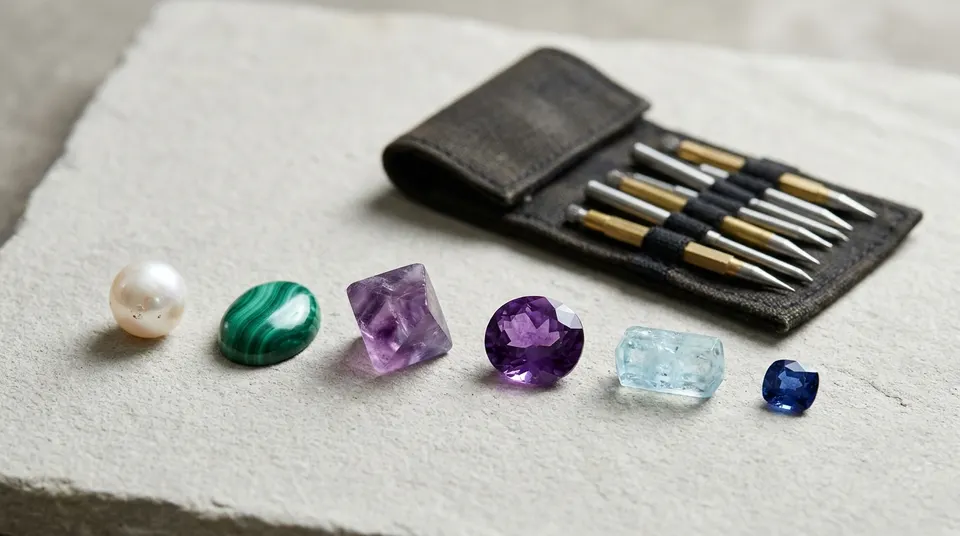
Quick Answer
Stones at 7 or above on the Mohs scale, like quartz (amethyst, citrine, rose and clear quartz), tourmaline, aquamarine and sapphire, handle daily wear well. Stones below 7 scratch more easily: moonstone and labradorite (6 to 6.5), opal (5 to 6.5), turquoise (5 to 6), lapis lazuli (5 to 5.5), fluorite (4), malachite (3.5 to 4) and pearl (2.5 to 3). Wear softer stones in earrings and pendants, not everyday rings.
On this page
Key Takeaways
- The Mohs scale ranks scratch resistance from 1 (talc) to 10 (diamond); it is relative, not evenly spaced.
- Quartz sits at 7. Stones below 7, such as moonstone, opal, turquoise, lapis lazuli, fluorite and malachite, scratch more easily in daily wear.
- Hardness is only one part of durability: toughness (resistance to chipping) and stability (heat, light, chemicals) matter too.
- Softer stones last longer in earrings, pendants and brooches than in rings and bracelets.
- Never scratch-test finished jewelry or a seller's stone; only a gem lab can identify a stone with certainty.
What Is the Mohs Hardness Scale?
The Mohs scale ranks how well a mineral resists scratching. It was developed in 1822 by the Austrian mineralogist Friedrich Mohs, who picked 10 reference minerals and ordered them so that each one scratches the minerals below it [2]. The 10 reference points are talc (1), gypsum (2), calcite (3), fluorite (4), apatite (5), feldspar or orthoclase (6), quartz (7), topaz (8), corundum, the mineral of ruby and sapphire (9), and diamond (10).
The Mohs scale is relative, not evenly spaced: diamond at 10 is many times harder than corundum at 9. GIA points this out directly, and adds that only diamond can scratch diamond, while corundum can scratch topaz, quartz and anything softer [1]. So a jump from 6 to 7 is a meaningful step up in scratch resistance, but the numbers are ranks, not measurements.
For scale, the Kansas Geological Survey gives a fingernail a hardness of 2.5, a pocketknife blade 5.5, and glass slightly less than 6 [3]. A stone below about 6 can pick up marks from ordinary metal and grit that would not touch a quartz bead.
Which Crystals and Gemstones Scratch Easily?
A common rule of thumb treats 7, the hardness of quartz, as the line between stones that cope with daily knocks and stones that need more care. Sand and grit often contain quartz, so anything softer than 7 can slowly lose its polish from contact with everyday dirt, tabletops and other jewelry. The table below lists published Mohs values for common jewelry stones. GIA's Gem Encyclopedia gives aquamarine and emerald 7.5 to 8 [9] [10], tourmaline 7 to 7.5 [11], tanzanite 6 to 7 [12] and pearl 2.5 to 3 [13].
| Stone | Mohs hardness | Everyday ring or bracelet? | Note | Source |
|---|---|---|---|---|
| Diamond | 10 | Yes | Can still chip from a hard blow | USGS, GIA |
| Ruby, sapphire (corundum) | 9 | Yes | Will scratch softer stones stored with it | USGS, GIA |
| Aquamarine | 7.5-8 | Yes | Beryl family | GIA |
| Emerald | 7.5-8 | With care | Often oil- or resin-filled; no ultrasonic | GIA |
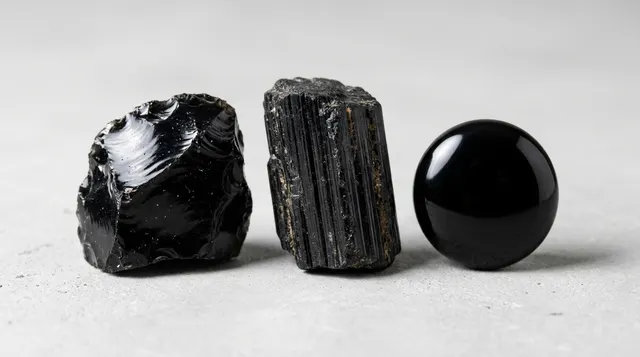
| Tourmaline | 7-7.5 | Yes | Includes black tourmaline | GIA, USGS |
| Amethyst, citrine, rose and clear quartz | 7 | Yes | Some colors fade in strong light | GIA, USGS |
| Garnet | 6.5-7.5 | Mostly | Varies by type | USGS |
| Tanzanite | 6-7 | Occasional | Sensitive to sudden temperature change | GIA |
| Moonstone, labradorite (feldspar) | 6-6.5 | Occasional | Polish dulls with wear | GIA, USGS |
| Pyrite | 6-6.5 | Occasional | Metallic luster shows scratches | KGS |
| Opal | 5-6.5 | Occasional, in a bezel | Contains water; can craze if it dries out | GIA, USGS |
| Turquoise | 5-6 | Occasional | Porous; absorbs oils and liquids | GIA, USGS |
| Lapis lazuli | 5-5.5 | Occasional | A rock, so hardness varies | USGS |
| Fluorite | 4 | No | A Mohs reference mineral | USGS |
| Malachite | 3.5-4 | No | Damaged by ammonia and long soaking | KGS, GIA |
| Pearl | 2.5-3 | No | Put on last, take off first | GIA |
| Lepidolite (mica group) | 1.5-3 | No | Mica group figure; very soft | KGS |
The quartz family is the backbone of most crystal jewelry, and USGS lists quartz at 7, including rock crystal, amethyst, citrine and rose quartz [2]. GIA's entry for amethyst gives the same 7 [8], which is why amethyst and clear quartz beads and rings hold their polish well. USGS lists chalcedony varieties such as agate and carnelian alongside quartz but marks their hardness as variable rather than giving a single number, so treat them as close to quartz rather than identical.
Feldspar stones are a step softer. GIA lists moonstone at 6 to 6.5 [5], and USGS gives the whole feldspar group, which includes labradorite, 6 to 6.5. They are fine in pendants and earrings, but a moonstone ring worn daily will usually show a hazy surface sooner than a quartz ring.
Below 6, the list includes several of the most popular "crystal" stones. GIA gives opal 5 to 6.5 and turquoise 5 to 6 [6] [7], USGS gives lapis lazuli 5 to 5.5, and the Kansas Geological Survey gives malachite 3.5 to 4. Fluorite is the Mohs reference mineral for 4, softer than a knife blade. A fluorite or malachite ring can scuff from ordinary daily contact, so these stones suit pieces that rarely touch hard surfaces.
Is Hardness the Same as Durability?
No. GIA describes durability as a combination of three things: hardness (scratch resistance), toughness (resistance to breaking and chipping) and stability (resistance to heat, light, chemicals and humidity), and notes that no single gemstone scores a "perfect 10" on all three [1].
- Toughness. Diamond is the hardest gem, but GIA notes that a hard blow can still cleave or fracture it, and that nephrite and jadeite jade are far tougher than diamond on a fracture-toughness scale. Pointed shapes and thin edges chip more easily whatever the hardness.
- Stability. GIA lists opal, tanzanite, apatite, iolite and kunzite as stones that sudden temperature changes can damage. Opal can crack or craze if it dries out. Prolonged water exposure can damage malachite, and ammonia damages malachite, turquoise and coral. Citrine, amethyst, kunzite and topaz can fade with long exposure to light; our guide to crystals that fade in sunlight covers that in detail.
- Treatments. GIA notes that coatings and fracture fillings are not permanent and can be removed by heat or strong chemicals, and that oil- or resin-filled emeralds can be damaged by ultrasonic cleaning or solvents.
A high Mohs number tells you a stone resists scratches; it does not tell you the stone will not chip, crack or fade. That is why a hard stone like emerald still needs gentle cleaning, and why cleaning methods should match each stone; see how to clean crystal jewelry without damaging it.
Which Jewelry Styles Suit Softer Stones?
Where a stone sits on your body matters as much as its hardness. Rings and bracelets take the most knocks, from door handles, desks, bag straps and dishes. Earrings, pendants and brooches sit away from those contact points. GIA's own advice for vulnerable gems such as opal and tanzanite is to choose earrings or necklaces over bracelets or rings, to wear softer gems on special occasions rather than every day, and to pick bezel, partial-bezel or V-shaped prong settings that cover exposed points [1].
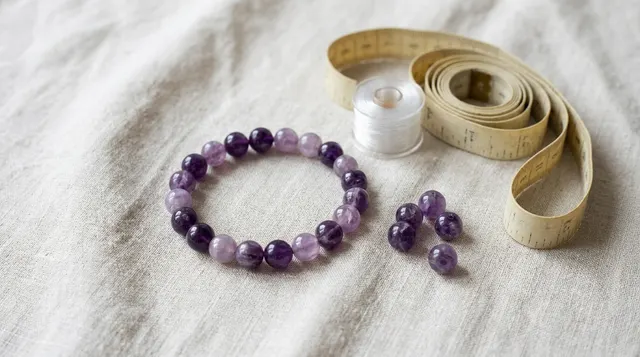
Bead bracelets need a special mention. A strand of 8 mm (about 0.3 in) beads rubs bead against bead with every movement of the wrist, and it hits table edges and keyboards all day. Quartz beads cope with that well. Softer beads, such as fluorite, malachite or lepidolite, will show worn, matte spots where they touch. Mixing hard and soft beads on one strand also lets the harder beads slowly scratch the softer ones.
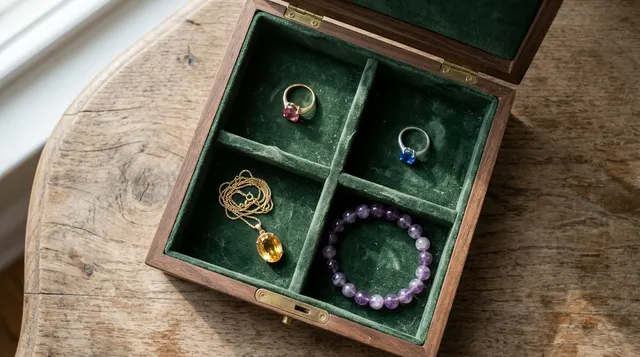
Storage follows the same logic. GIA advises keeping diamonds away from softer gems such as topaz because diamond can scratch them, and the same applies all the way down the scale: a quartz point tossed into a pouch with a fluorite bracelet will mark it. Keep each piece in its own compartment or soft pouch. The care chart lists hardness alongside water, sunlight and ultrasonic notes for each stone, and the jewelry finder can suggest pieces by how often you plan to wear them.
Can You Test a Stone's Hardness at Home?
Only with care, and never on jewelry. A Mohs hardness kit is a set of reference points, minerals or metal picks of known hardness, used by rock and mineral hobbyists to narrow down what a rough specimen might be. Geology teaching materials, such as the Kansas Geological Survey's identification tables, use exactly this approach: whether a knife blade or a piece of quartz can scratch a sample helps sort it into a group [4].
That method has firm limits for jewelry buyers:
- A scratch test leaves a scratch. Never test a finished ring, pendant or bracelet, a polished stone you plan to wear, or any stone you do not own, including a seller's stock. If you use a kit at all, use it on a rough specimen you own, on a hidden spot, and press lightly.
- It suggests, it does not prove. Many different materials share a hardness range. Glass and several natural stones fall in a similar band, and treated, dyed or stabilized stones can behave differently from untreated ones.
- Certainty comes from a lab. A gem lab such as GIA identifies stones with refractive index readings, spectroscopy and microscopy, and can report treatments. GIA recommends a lab report when you want to know whether a gem has been treated, because it guides how to clean and care for it [1].
For checking whether a purple stone is natural quartz or glass, gentler signs like color zoning and inclusions are covered in how to tell if amethyst is real.
Useful for this guide
Mohs Hardness Test Kit
Check price on AmazonUnited Scientific™ Mineral ID Kit
Check price on Amazon
Frequently Asked Questions
What Mohs hardness is good for an everyday ring?
A common rule of thumb is 7 as the practical minimum for a ring worn every day, which is the hardness of quartz. Sapphire, ruby and diamond go well beyond that. Stones between 6 and 7 can work in a bezel setting with occasional wear, while stones below 6 are better kept for pendants and earrings.
Is amethyst hard enough for daily wear?
Yes, for scratch resistance. GIA lists amethyst at 7 on the Mohs scale. It can fade with long exposure to strong light, and, like any stone, it can chip from a hard knock, so take rings off for heavy work and store them away from harder gems.
Why does my crystal bracelet look dull and scratched?
Usually because the beads are softer than the grit and surfaces they touch every day, and because they rub against each other. Fluorite, malachite, lepidolite and other stones below 7 lose their polish faster on the wrist. Store the bracelet on its own and take it off for washing up, the gym and gardening.
Can a harder stone scratch a softer one in my jewelry box?
Yes. Any mineral can scratch minerals below it on the Mohs scale. GIA specifically warns against storing diamonds next to softer gems such as topaz. Keep quartz, sapphire and diamond pieces in separate compartments from opal, pearl, turquoise and fluorite.
Does a higher Mohs number mean a stone will not break?
No. Mohs measures scratch resistance only. Toughness, the resistance to chipping and breaking, is separate: GIA notes that jade is far tougher than diamond, and diamond can cleave from a hard blow along certain directions.
Our Take
We think the Mohs number is the single most useful fact to check before you buy a crystal ring or bracelet, and one that is easy to overlook in product listings. In our view, 7 is a sensible line: at or above it, wear the piece freely; below it, choose a pendant or earrings, or accept that a ring will need gentle treatment and an occasional re-polish. We would not let hardness rule out a stone you love, though. A malachite pendant or a pair of opal earrings can last for decades when it sits away from hands and wrists. Hardness tells you where a stone belongs, not whether it is worth owning.
Sources
- More than the Mohs Scale: Understanding Gem Durability. GIA.
- Natural Gemstones - Mineral Gemstones. USGS.
- Kansas Rocks and Minerals: Minerals. Kansas Geological Survey.
- Kansas Rocks and Minerals: Mineral Identification. Kansas Geological Survey.
- Moonstone Gemstone. GIA.
- Opal Gemstone. GIA.
- Turquoise Gemstone. GIA.
- Amethyst Gemstone. GIA.
- Aquamarine Gemstone. GIA.
- Emerald Gemstone. GIA.
- Tourmaline Gemstone. GIA.
- Tanzanite Gemstone. GIA.
- Pearl Gemstone. GIA.
Crystal Field Guide covers mineralogy, identification and care. We make no claims that any stone affects health, mood or fortune. Home checks can only suggest an answer; for certainty about a valuable stone, ask an accredited gem lab. Spotted an error? Tell us.
More Crystal Guides
How to Clean Crystal Jewelry Without Damaging It
Clean crystal jewelry with warm water, mild soap and a soft brush. Which stones must skip ultrasonic, steam and chemical cleaners, and why GIA says so.
Which Crystals Fade in Sunlight? A Stone-by-Stone Guide
Which crystals fade in sunlight: what GIA says about amethyst, citrine, kunzite, topaz and rose quartz, why dyed stones fade, and how to display stones safely.
How to Tell If Amethyst Is Real: Natural, Synthetic and Glass
How to tell real amethyst from synthetic quartz and glass: color zoning, bubbles, refractive index, heat treatment, and when only a gem lab can be sure.
How to Store Crystal Jewelry and Stones Without Scratches
Store crystal jewelry by hardness: a pouch or slot per piece, soft stones and pearls kept apart, away from strong light, heat and plastic bags. Stone by stone.
Obsidian vs Black Tourmaline vs Onyx: How to Tell Them Apart
Obsidian is volcanic glass, black tourmaline is a striated crystal, black onyx is dyed chalcedony. Shape, fracture, banding and lab tests that tell them apart.
Crystal Bead Bracelet Size Guide: Wrist Size and Bead mm
How to measure your wrist, how much length to add for 4 to 12 mm beads, how many beads a bracelet needs, and how bead size changes weight and fit.