Crystal Bead Bracelet Size Guide: Wrist Size and Bead mm
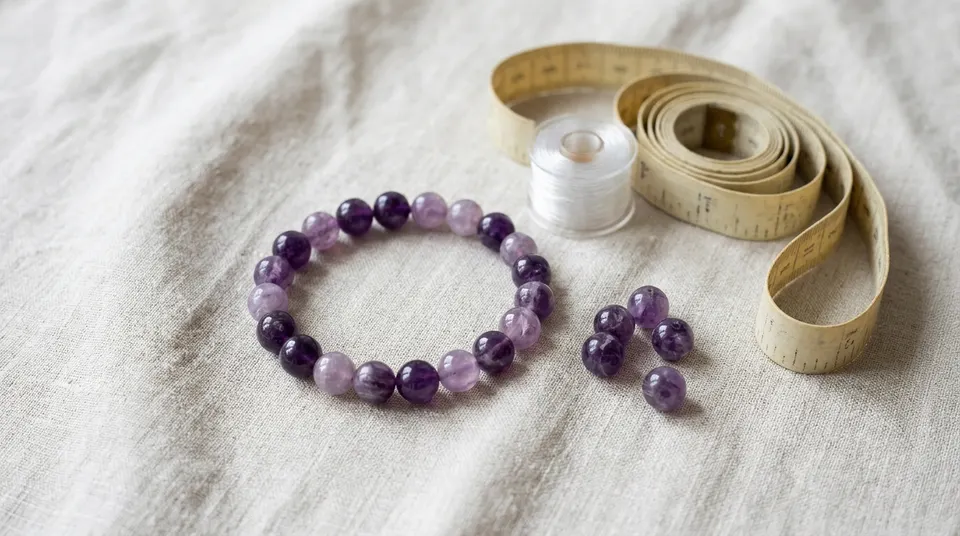
Quick Answer
Measure your wrist snugly in millimetres. Add 3.14 times the bead diameter, because the cord sits at the bead centers, then add your comfort ease: 0 mm for snug, about 6 mm for comfortable, about 13 mm for loose. Divide that total by the bead size to get the bead count. For a 6 inch (152 mm) wrist and 8 mm beads, a comfortable bracelet is about 184 mm, or 23 beads.
On this page
- How Do You Measure Your Wrist for a Bead Bracelet?
- How Much Should You Add to Your Wrist Size for Bead Size?
- How Many Beads Do You Need for a Bracelet?
- Does Bead Size Change How a Bracelet Wears?
- Stretch Cord, Knotted or Clasp: Which Bracelet Style Fits Better?
- How Do You Read a Bracelet Size Listing Before You Buy?
- Frequently Asked Questions
- Our Take
- Sources
Key Takeaways
- Measure your bare wrist just below the wrist bone, snug but not tight, and write it down in both inches and millimetres (1 inch = 25.4 mm).
- The inside of a bead bracelet is shorter than its length along the cord by about 3.14 times the bead diameter, so add that first: about 25 mm (1 inch) for 8 mm beads.
- Then add comfort ease: nothing for snug, about 6 mm (1/4 inch) for comfortable, about 13 mm (1/2 inch) for loose.
- Bead count = bracelet length in mm divided by bead size in mm, rounded to a whole bead.
- Bigger beads are much heavier: a 12 mm bead weighs over three times as much as an 8 mm bead of the same stone, which strains stretch cord.
How Do You Measure Your Wrist for a Bead Bracelet?
Measure the wrist you will wear the bracelet on, at the spot where it will sit: just below the round wrist bone, toward the hand. Use a soft tailor's tape, or wrap a strip of paper or a piece of non-stretch string around the wrist, mark where it meets, and lay it flat against a ruler.
A few habits make the number more useful:
- Snug, not tight. The tape should touch the skin all the way around without pressing in. Don't add any slack yet; the ease comes in the next step.
- Measure twice, at different times of day. Wrists can be a little larger in heat or after exercise. If the two numbers differ, use the larger one.
- Write it in millimetres. Bead sizes are sold in millimetres, so millimetres make the arithmetic easy. The inch is defined as exactly 25.4 mm [1], so multiply inches by 25.4. A 6 inch wrist is 152.4 mm; a 6.5 inch wrist is 165.1 mm; a 7 inch wrist is 177.8 mm.
If you already own a bead bracelet that fits well, measure that too. Lay it flat in a circle, measure the inside diameter across the middle, and multiply by 3.14. That gives the inner circumference, the number that matters most for fit, and it is a good check on your tape measurement.
How Much Should You Add to Your Wrist Size for Bead Size?
This is the step most size charts skip. A bead bracelet's inner circumference is shorter than its length along the cord by about 3.14 times the bead diameter. The cord runs through the center of every bead, so the circle it makes sits half a bead away from your skin. Moving inward by half a bead on every side shrinks the circle's diameter by one full bead, and a circle's circumference is 3.14 times its diameter.
So the bracelet length you want is your wrist measurement, plus 3.14 times the bead size, plus whatever comfort ease you like. The comfort ease below is a starting point, not a standard; fit is personal.
| Bead size | Geometry add (3.14 × d) | Snug total add | Comfortable total add (+6 mm) | Loose total add (+13 mm) |
|---|---|---|---|---|
| 4 mm (0.16 in) | 13 mm (0.49 in) | 13 mm (0.5 in) | 19 mm (0.7 in) | 26 mm (1.0 in) |
| 6 mm (0.24 in) | 19 mm (0.74 in) | 19 mm (0.7 in) | 25 mm (1.0 in) | 32 mm (1.3 in) |
| 8 mm (0.31 in) | 25 mm (0.99 in) | 25 mm (1.0 in) | 31 mm (1.2 in) | 38 mm (1.5 in) |
| 10 mm (0.39 in) | 31 mm (1.24 in) | 31 mm (1.2 in) | 37 mm (1.5 in) | 44 mm (1.7 in) |
| 12 mm (0.47 in) | 38 mm (1.48 in) | 38 mm (1.5 in) | 44 mm (1.7 in) | 51 mm (2.0 in) |
Two things to keep in mind. First, wrists are oval rather than round, so large beads leave small gaps at the sides and press a little more at the top and bottom of the wrist. Second, a stretch bracelet also has to roll over the widest part of your hand. A snug fit on the wrist means more stretching every time you put it on, which wears out elastic faster.
How Many Beads Do You Need for a Bracelet?
Bead count equals the bracelet length in millimetres divided by the bead size in millimetres. Round to the nearest whole bead, and remember that each bead you add or remove changes the length by one bead diameter: 8 mm per bead with 8 mm beads.
If you already know the finished length you want, this table gives the bead count directly.
| Finished length | 6 mm beads | 8 mm beads | 10 mm beads |
|---|---|---|---|
| 6.5 in (165 mm) | 28 | 21 | 17 |
| 7 in (178 mm) | 30 | 22 | 18 |
| 7.5 in (191 mm) | 32 | 24 | 19 |
| 8 in (203 mm) | 34 | 25 | 20 |
Natural stone beads are rarely exactly their nominal size. A strand sold as "8 mm" can include beads a little larger or smaller, and spacers, metal accents or a focal bead change the total too. When you design or restring a bracelet, lay the beads out on a ruler or a bead board and measure the real length before you tie off, rather than trusting the count alone. If the bracelet uses knots between beads, each knot adds a little length as well.
Does Bead Size Change How a Bracelet Wears?
Yes, and weight is the part people underestimate. A bead's weight grows with the cube of its diameter, so a 12 mm bead weighs about 3.4 times as much as an 8 mm bead of the same stone. Amethyst, a variety of quartz, has a specific gravity of 2.66 [2], meaning it is 2.66 times as dense as water. From that, a solid 8 mm amethyst sphere weighs about 0.7 g, and a 12 mm sphere about 2.4 g, before the drill hole is subtracted.
That weight matters in three ways:
- Cord strain. Heavier beads pull harder on stretch cord every time the bracelet swings or knocks against a desk. Large-bead bracelets usually need thicker cord, and they tend to need restringing sooner.
- Fit. Big beads stand taller off the wrist and leave more of the geometry gap described above, so they need more added length.
- Material differences. Stones vary in density. Lapis lazuli is listed at a specific gravity of 2.75, give or take 0.25 [3], close to quartz, but density varies from stone to stone, so two bracelets with the same bead size can feel different in the hand. If you are choosing between materials, the care chart puts hardness and handling notes side by side.
Small beads (4-6 mm) suit narrow wrists, stacking and everyday wear. Medium beads (8 mm) are the most common size for single bracelets. Large beads (10-12 mm) are bolder and heavier. If you are unsure which style suits how you'll wear it, the jewelry finder sorts options by daily wear and style.
Stretch Cord, Knotted or Clasp: Which Bracelet Style Fits Better?
The way a bracelet is strung changes how you size it.
| Style | How it goes on | Sizing tip | Main wear point |
|---|---|---|---|
| Stretch (elastic) cord | Rolls over the hand | Use the comfortable or loose ease; snug fits stretch the cord more | Elastic loosens and weakens with use |
| Knotted silk or nylon | Usually a clasp | Knots add length; measure the finished strand | Thread can stretch, darken or wear thin |
| Wire with a clasp | Opens at the clasp | Clasp and jump rings add length; count them in | Clasp and crimps |
GIA's care advice for pearls, which are traditionally strung on knotted silk, describes a problem that applies to any strung bracelet: over the years, the string stretches and weakens, and a jeweler can restring it [4]. GIA also notes that most pearl necklaces are knotted so that if the string breaks, only one pearl comes loose, and that the silk can darken, stretch or wear thin over time [5]. The same buyer's guide says knots between pearls also keep them from rubbing against each other.
For stretch bracelets, a few habits help the cord last:
- Roll it on and off. Pulling the bracelet wide over your knuckles strains the elastic more than rolling it over the hand.
- Let a wet bracelet dry fully. GIA advises that strung pearls should only be worn once the string is completely dry [6]. Treat any strung bracelet the same way.
- Keep sprays and lotions off the cord. Put on hairspray, perfume and lotion before your bracelet. Our guide on how to clean crystal jewelry covers safe cleaning for strung pieces.
- Watch for mixed hardness. On a bracelet, beads rub against each other all day. Amethyst has a Mohs hardness of 7 [2], so it can scuff softer beads strung next to it. See Mohs hardness for crystal jewelry for which stones scratch easily.
How Do You Read a Bracelet Size Listing Before You Buy?
Size listings for bead bracelets are not standardized, and two shops can mean different things by "7 inches." Before you order, check four things:
- What the length measures. Some sellers give the length along the cord (bead count times bead size), others give the inner circumference. A 7 inch cord length with 8 mm beads fits like roughly a 6 inch inner circle. If the listing doesn't say, ask.
- The bead size in millimetres. Without it, you can't apply the geometry add. If only a bead count and length are given, divide one by the other.
- Whether the bracelet can be resized. Stretch bracelets can usually be restrung with beads added or removed; clasp bracelets can sometimes take an extender.
- What the beads are. Listings for natural-looking beads sometimes leave out dyeing or the fact that the "stone" is glass. Our guides on how to spot dyed crystals and rose quartz vs pink glass explain what to look for, and their limits: a photo or a quick look can suggest, but only a gem lab can confirm what a material is.
You can compare bead materials on stone profiles such as amethyst, and browse bracelet supplies in the shop.
Useful for this guide
Paxcoo Elastic Bracelet String Cord Stretch Bead Cord for Jewelry Making and Bracelets
Check price on Amazon0.8mm Elastic Bracelet String Cord
Check price on Amazon1mm Stretchy Bracelet String, Sturdy Rainbow Elastic String Elastic Cord for Jewelry
Check price on Amazon
Frequently Asked Questions
What size bead bracelet fits a 6 inch wrist?
With 8 mm beads, a comfortable fit is about 183-184 mm (about 7.2 inches), or 23 beads: 152 mm for the wrist, plus 25 mm for the bead geometry, plus 6 mm of ease. With 6 mm beads, about 180 mm (7.1 inches) works, which is 30 beads. If you like a snug fit, take off one bead.
What size bead bracelet fits a 7 inch wrist?
A 7 inch wrist is 177.8 mm. With 8 mm beads and comfortable ease, aim for about 208 mm (about 8.2 inches), or 26 beads. With 6 mm beads, about 204 mm (8 inches), or 34 beads. Larger beads need even more length.
Is 8 mm or 10 mm better for a bead bracelet?
Neither is better; it depends on your wrist and style. An 8 mm bracelet is lighter and sits closer to the wrist. A 10 mm bracelet is bolder but heavier: about 1.5 times the weight for the same length in the same stone, and it needs about 6 mm more length to fit the same wrist.
How do I know if my stretch bracelet is too small?
Signs include beads pressing marks into your skin, gaps showing between beads when it is on your wrist (the elastic is stretched), and the bracelet being hard to roll over your hand. A bracelet that fits should sit with the beads touching each other and the cord hidden.
Can a stretch bead bracelet be resized?
Usually yes. It can be restrung on new elastic with beads added or removed, changing the length by one bead diameter per bead. A jeweler or bead shop can do it if you do not want to restring it yourself.
Our Take
We think the most common sizing mistake is treating a bead bracelet like a chain bracelet and adding a fixed half inch no matter the bead size. In our view, the 3.14 × bead diameter rule is worth learning because it explains why the same wrist needs a longer bracelet with bigger beads, and it lets you check any seller's chart in your head. We'd also lean toward the comfortable fit over the snug one for stretch cord, since a bracelet that has to stretch to go on wears out sooner. And for anyone torn between sizes, we'd pick the smaller bead: lighter on the wrist and on the cord.
Sources
- SI Units – Length. NIST.
- Amethyst. GIA.
- Lapis Lazuli. GIA.
- Pearl Buyer's Guide. GIA.
- How should I care for my pearls?. GIA.
- Pearl Care and Cleaning Guide. GIA.
Crystal Field Guide covers mineralogy, identification and care. We make no claims that any stone affects health, mood or fortune. Home checks can only suggest an answer; for certainty about a valuable stone, ask an accredited gem lab. Spotted an error? Tell us.
More Crystal Guides
Mohs Hardness for Crystal Jewelry: Which Stones Scratch Easily?
Mohs hardness for crystal jewelry: which stones scratch easily, why 7 is the everyday-wear line, and how to match soft stones to rings, pendants and earrings.
How to Clean Crystal Jewelry Without Damaging It
Clean crystal jewelry with warm water, mild soap and a soft brush. Which stones must skip ultrasonic, steam and chemical cleaners, and why GIA says so.
How to Store Crystal Jewelry and Stones Without Scratches
Store crystal jewelry by hardness: a pouch or slot per piece, soft stones and pearls kept apart, away from strong light, heat and plastic bags. Stone by stone.
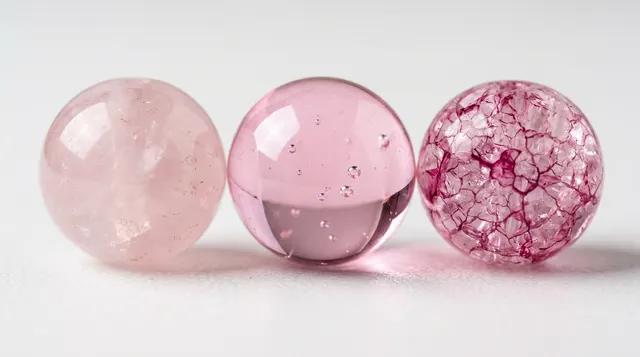
Rose Quartz vs Pink Glass vs Dyed Quartz: How to Tell
How to tell natural rose quartz from pink glass and dyed quartz: color, clarity, gas bubbles, dye-filled cracks, hardness, FTC disclosure rules and lab tests.
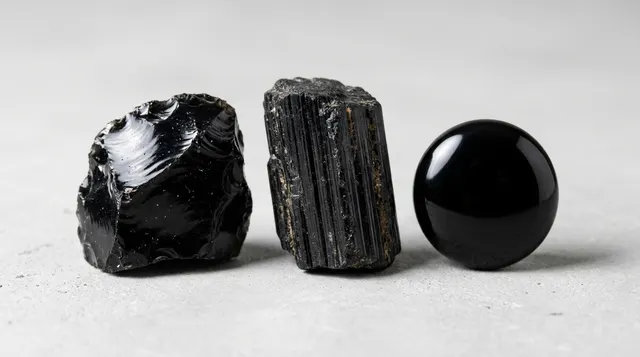
Obsidian vs Black Tourmaline vs Onyx: How to Tell Them Apart
Obsidian is volcanic glass, black tourmaline is a striated crystal, black onyx is dyed chalcedony. Shape, fracture, banding and lab tests that tell them apart.
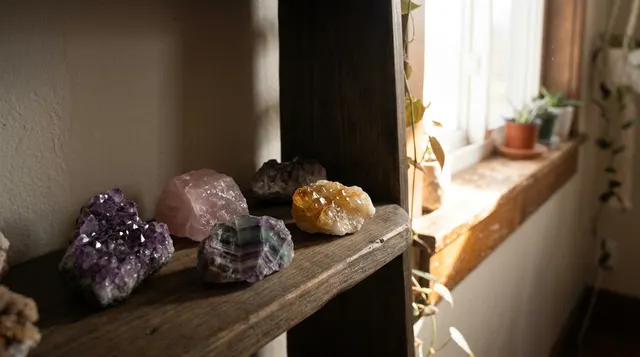
Which Crystals Fade in Sunlight? A Stone-by-Stone Guide
Which crystals fade in sunlight: what GIA says about amethyst, citrine, kunzite, topaz and rose quartz, why dyed stones fade, and how to display stones safely.