Obsidian vs Black Tourmaline vs Onyx: How to Tell Them Apart
Quick Answer
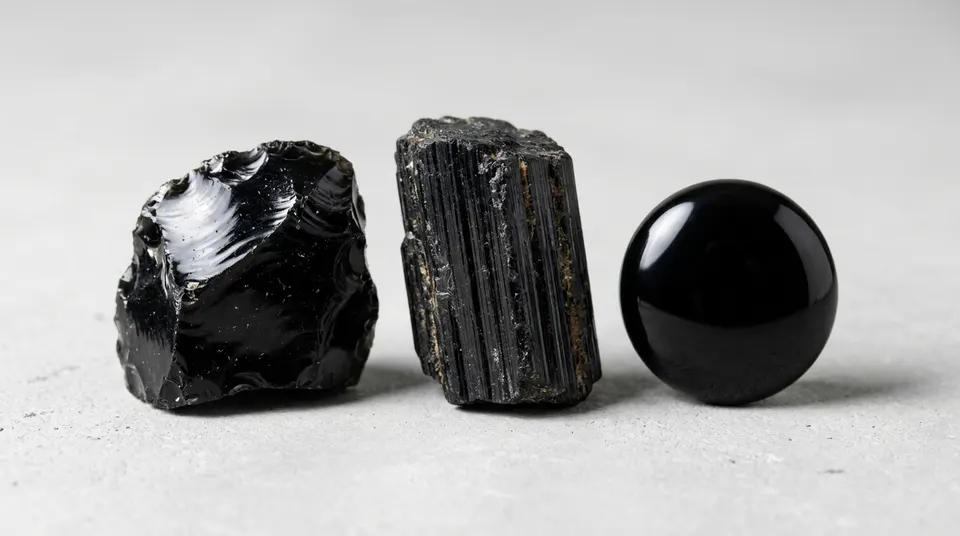
Look at shape and surface first. Black tourmaline grows as long crystals with fine grooves running along their length and a rounded triangular cross-section. Obsidian is volcanic glass: glassy shine, smooth curved chips and sometimes stretched bubbles under a loupe. Black onyx is dyed chalcedony with an even, waxy black and faint bands at a thin edge under strong light. For polished stones, only a gem lab can confirm which is which.
On this page
- What Is the Difference Between Obsidian, Black Tourmaline and Onyx?
- How Can You Tell Black Tourmaline Apart by Its Crystal Shape?
- How Do You Spot Obsidian and Tell It From Black Glass?
- How Do You Know If Black Onyx Is Dyed or Natural?
- Can a Scratch Test or Hardness Kit Tell Them Apart?
- When Do You Need a Gem Lab?
- Frequently Asked Questions
- Our Take
- Sources
Key Takeaways
- Obsidian is glass with no crystal structure; black tourmaline is a crystal with lengthwise grooves; black onyx is microcrystalline quartz (chalcedony), usually dyed.
- Rough black tourmaline is the easiest to spot: long, grooved crystals with a three-sided outline.
- A uniform jet-black onyx is normally dyed; GIA says virtually all black chalcedony on the market is treated.
- Polished beads and cabochons often cannot be told apart by eye. Certainty needs refractive index, specific gravity or other lab tests.
- Never scratch-test finished jewelry or a seller's stone; hardness testing damages the piece.
What Is the Difference Between Obsidian, Black Tourmaline and Onyx?
The three stones differ in what they are made of and how their atoms are arranged, and that difference drives everything you can see.
Obsidian is glass made by a volcano. Calvin University's geology collection describes it as an extrusive igneous rock that forms when silica-rich molten rock cools so fast that its atoms cannot arrange themselves into crystals; the result is a volcanic glass with a smooth, uniform texture that breaks conchoidally [8]. James Madison University's rock guide adds that typical obsidian is very black, shiny and glassy, with smooth curved breaks that often show concentric ridges [9]. Because it is a rock-glass rather than a mineral, it has no crystal faces of its own. See the obsidian profile for its varieties.
Black tourmaline is a crystal. GIA lists schorl as one of the five major tourmaline species, typically black and rich in iron, and notes that it is rarely used as a gem, although it appeared in mourning jewelry [2]. The Handbook of Mineralogy describes schorl crystals as prismatic, with a prominent trigonal (three-sided) prism, commonly striated parallel to their length, and reaching up to 1.5 m (about 5 feet) [7]. More on the black tourmaline profile.
Black onyx is (usually) dyed chalcedony. GIA explains that onyx, like agate and jasper, is a variety of chalcedony, a microcrystalline quartz, and that natural onyx is made of straight parallel layers of different colors. It also states that what many call "black onyx" is actually dyed black chalcedony, and that natural black chalcedony is rare, so virtually all of it is treated [4]. If a piece of "onyx" is a perfectly even, deep black, assume it has been dyed unless a lab report says otherwise.
| Feature | Obsidian | Black tourmaline (schorl) | Black onyx |
|---|---|---|---|
| What it is | Natural volcanic glass | Single-crystal mineral | Chalcedony (microcrystalline quartz), usually dyed |
| Mohs hardness | About 6 (GCC collection) | 7 to 7.5 (GIA) | 7 (GIA) |
| Natural shape | Glassy masses, no crystal faces | Long prisms, 3-sided outline, lengthwise grooves | Layers in nodules and veins |
| Fracture | Glassy, smooth, curved (conchoidal) | Uneven to conchoidal, brittle | Waxy, fine-grained, can look conchoidal |
| Luster | Glassy | Glassy to resinous | Waxy to glassy when polished |
| Tell-tale signs | Stretched bubbles, smooth shell-like breaks | Grooves, triangular cross-section, white streak | Even black, faint bands at a thin edge |
| Common treatment | Rarely treated | Rarely treated | Dyed black (disclosure required) |
Hardness sources: Greenfield Community College's geology collection lists its obsidian sample at 6 on the Mohs scale [10]; GIA gives 7 to 7.5 for tourmaline [1] and 7 for onyx (GIA blog above). Obsidian figures vary between references because glass composition varies, so treat that number as approximate.
How Can You Tell Black Tourmaline Apart by Its Crystal Shape?
Rough or raw black tourmaline is the one stone of the three you can often recognize on sight, because its crystal form survives. Look for three things:
- Grooves along the length. Fine parallel ridges, called striations, run from one end of the crystal to the other. The Handbook of Mineralogy notes that schorl is commonly striated parallel to its long axis [7].
- A three-sided outline. Look at the broken end of a crystal. The trigonal prism gives it a rounded triangular cross-section rather than a round or square one.
- Long, pencil-like proportions. GIA notes that the elongated shape of many tourmaline crystals affects how gems are cut, which is why cutters often follow the crystal's length [3].
Obsidian never shows these features, because glass does not grow crystal faces. Chalcedony is a mass of crystals too small to see, so it does not form big prisms either.
Two more home clues for tourmaline: the Handbook lists a white streak and a vitreous to resinous luster for schorl, and a measured density of 3.18 to 3.22 [7]. Density is something a lab measures precisely; by hand it is only a vague impression. A streak test means rubbing the stone on unglazed porcelain, and GIA's black-opaque study calls it a destructive test that must be made carefully [6], so it belongs on your own rough specimens only.
How Do You Spot Obsidian and Tell It From Black Glass?
Obsidian's clues come from being glass. Its broken edges are smooth and curved, like the inside of a shell, and razor sharp. Calvin University notes that this conchoidal fracture is why ancient cultures shaped obsidian into knives, arrowheads and spear points [8]. Check the girdle of a cabochon or the drill hole of a bead with a loupe for small chips; a bright, glassy shell-shaped chip fits obsidian.
The harder problem is telling obsidian from man-made black glass, which is sold under many names. GIA's study of black opaque gems points to the inclusions: manufactured glass tends to hold round gas bubbles, while natural volcanic glass shows stretched gas bubbles and iron-titanium oxide inclusions [6]. Many black stones are too dark to see inside, so you may need a strong penlight held against a thin edge to see anything at all.
If you see perfectly round bubbles, mold seams or a surface that looks pressed rather than polished, suspect glass. For the wider picture on fakes and treated stones, our guide on how to spot dyed crystals covers the same loupe routine.
How Do You Know If Black Onyx Is Dyed or Natural?
For black onyx, the realistic question is not "dyed or natural" but "dyed chalcedony or something else". GIA's black-opaque study notes that a uniform black is often achieved by dyeing a porous material, and that the banding in a "black onyx" cabochon may be visible only on a very thin edge under strong fiber-optic light; the stone may have been a banded agate before treatment, or layers may have absorbed the dye differently [6].
What you can check at home:
- Color. An even, inky black with no zoning at all fits dyed chalcedony. Natural onyx shows straight bands of different colors.
- Thin edges. Shine a bright penlight through the thinnest edge of a bead hole or cabochon rim. Faint parallel bands support chalcedony.
- Chips. GIA notes that fine, compact aggregates such as chalcedony may break with a waxy, conchoidal surface, while glass and single crystals give a glassy one. A waxy chip points toward chalcedony.
Dyed black onyx is a durable, honest material when it is sold as what it is. In the United States, the FTC Guides say it is unfair or deceptive to fail to disclose a gemstone treatment that is not permanent, that creates special care requirements, or that significantly affects value [11]. Expect listings for black onyx to say "dyed".
Care follows from the dye. GIA advises keeping dyed gems away from solvents such as alcohol and acetone, which can remove many dyes, and out of prolonged sunlight, which can fade them [5]. Our crystal jewelry cleaning guide and the care chart set out safe cleaning for each stone, and which crystals fade in sunlight explains why dyes are the weak point.
Can a Scratch Test or Hardness Kit Tell Them Apart?
Only partly, and only on rough pieces you own. The numbers explain why: tourmaline (7 to 7.5) and onyx (7) sit so close together on the Mohs scale that a hardness kit barely separates them, while obsidian, at about 6, is softer than both.
GIA's black-opaque study lists hardness testing under tests that are not recommended for gemstones, because it requires scratching the sample [6]. Never scratch-test finished jewelry, a polished bead, or a stone that belongs to a seller. If you collect rough specimens and want to use a hardness kit, test only an unpolished, hidden spot of a piece you own, and read the result as a hint. Our Mohs hardness guide for crystal jewelry explains how hardness also predicts which stones scuff in daily wear.
When Do You Need a Gem Lab?
You need a lab whenever the answer matters: an expensive piece, a stone sold with a specific name, or polished beads with no visible clues. GIA's study opens by saying that refractive index, specific gravity and microscopic appearance give useful clues, but that in most cases advanced techniques such as X-ray diffraction or EDXRF spectroscopy are needed to identify a black opaque material, and even these may not be conclusive [6].
The refractive index gives a lab a quick first split. GIA lists tourmaline at 1.624 to 1.644 [1], and the Handbook of Mineralogy gives a measured density of 3.18 to 3.22 for schorl. A gemologist compares readings like these with the known values for chalcedony and glass, takes them from several spots on the stone, and does so without harming it.
When you buy, ask the seller to name the material and any treatment in writing. A clear listing for "dyed black onyx" or "obsidian" beats a vague "black crystal". If you are choosing a piece by look and daily wear rather than by identity, the jewelry finder sorts options by use, and the shop lists the tools mentioned here, including loupes and hardness kits for rough specimens.
Useful for this guide
Mohs Hardness Test Kit
Check price on AmazonUnited Scientific™ Mineral ID Kit
Check price on Amazon
Frequently Asked Questions
Is black onyx the same as obsidian?
No. Black onyx is chalcedony, a microcrystalline form of quartz that is almost always dyed black, while obsidian is natural volcanic glass with no crystal structure. Onyx is a little harder (7 on the Mohs scale versus about 6 for obsidian) and breaks with a waxier surface; obsidian breaks with glassy, shell-shaped edges.
Is black tourmaline the same as schorl?
Mostly, yes. Schorl is the iron-rich tourmaline species that is typically black, and it is what most "black tourmaline" specimens are. Other tourmaline species can also look very dark, so a gemologist uses refractive index and other tests to confirm the species.
Which is harder, black tourmaline or onyx?
They are almost the same. GIA lists tourmaline at 7 to 7.5 and onyx at 7 on the Mohs scale, so both resist everyday scratches better than obsidian. Tourmaline is brittle, though, and both can chip if knocked against a hard edge.
Can you tell these stones apart in a bead bracelet?
Often not by eye. Tumbling and drilling remove tourmaline's grooves and obsidian's chips, leaving three shiny black spheres. A loupe and a strong light at the drill hole may show bands or bubbles, but only lab tests can confirm the material.
Our Take
We think the most useful habit is to stop treating "black stone" as one category. In our view, rough black tourmaline is the only one of the three most buyers can name with confidence, thanks to its grooves and triangular outline. For polished pieces, we would trust a clear written description from the seller over any home test, and we would expect black onyx to be disclosed as dyed, because GIA says nearly all of it is. That is not a flaw: dyed onyx is a durable, sensible choice for everyday jewelry. And we would never scratch a stone to settle the question; a gem lab answers it without damage.
Sources
- Tourmaline. GIA.
- Tourmaline Description. GIA.
- Tourmaline Quality Factors. GIA.
- Wedding Anniversary Gemstone List: Years One through 10. GIA.
- An Introduction to Gem Treatments. GIA.
- Some Gemological Challenges in Identifying Black Opaque Gem Materials. GIA Gems & Gemology.
- Schorl. Handbook of Mineralogy.
- Obsidian - Volcanic Glass. Calvin University.
- Obsidian. James Madison University.
- R206 - Richard D. Little Geology Collection. Greenfield Community College.
- 16 CFR 23.24 - Disclosure of treatments to gemstones. Cornell Law School LII.
Crystal Field Guide covers mineralogy, identification and care. We make no claims that any stone affects health, mood or fortune. Home checks can only suggest an answer; for certainty about a valuable stone, ask an accredited gem lab. Spotted an error? Tell us.
More Crystal Guides
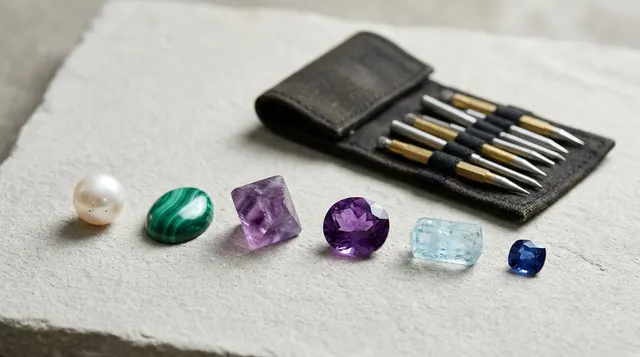
Mohs Hardness for Crystal Jewelry: Which Stones Scratch Easily?
Mohs hardness for crystal jewelry: which stones scratch easily, why 7 is the everyday-wear line, and how to match soft stones to rings, pendants and earrings.
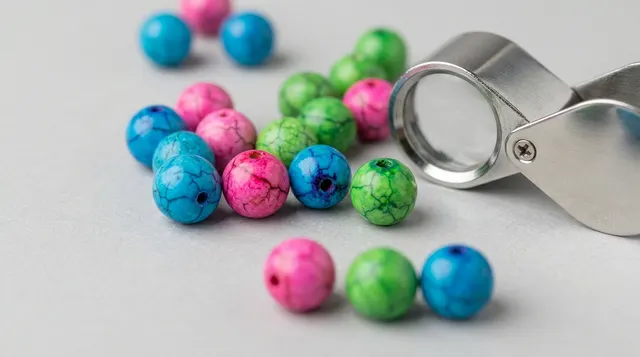
How to Spot Dyed Crystals and Stones
How to spot dyed crystals: color pooled in cracks and drill holes, hues not found in nature, howlite sold as turquoise, and when you need a gem lab to be sure.
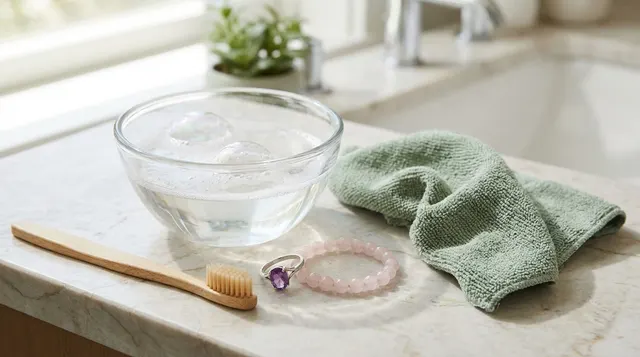
How to Clean Crystal Jewelry Without Damaging It
Clean crystal jewelry with warm water, mild soap and a soft brush. Which stones must skip ultrasonic, steam and chemical cleaners, and why GIA says so.
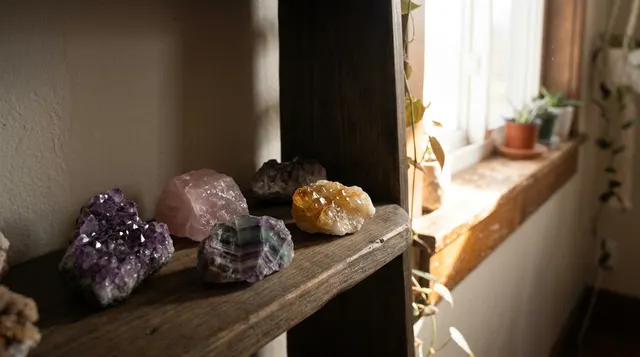
Which Crystals Fade in Sunlight? A Stone-by-Stone Guide
Which crystals fade in sunlight: what GIA says about amethyst, citrine, kunzite, topaz and rose quartz, why dyed stones fade, and how to display stones safely.
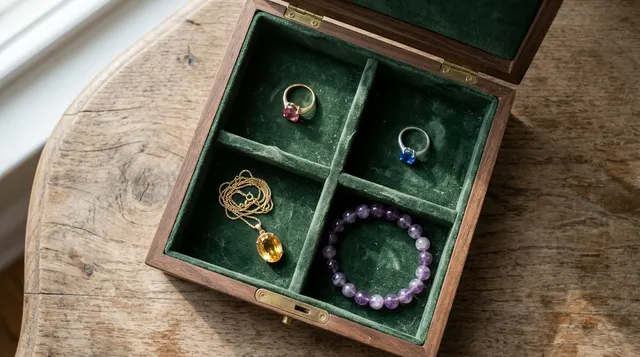
How to Store Crystal Jewelry and Stones Without Scratches
Store crystal jewelry by hardness: a pouch or slot per piece, soft stones and pearls kept apart, away from strong light, heat and plastic bags. Stone by stone.
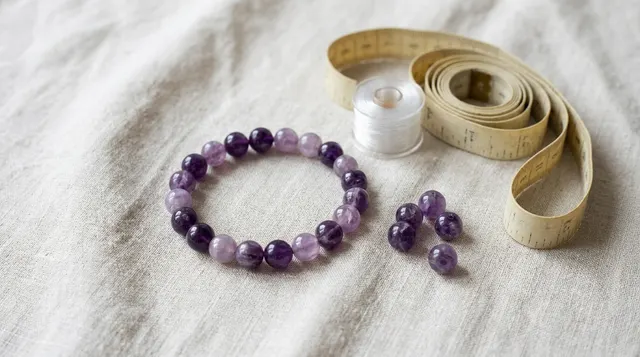
Crystal Bead Bracelet Size Guide: Wrist Size and Bead mm
How to measure your wrist, how much length to add for 4 to 12 mm beads, how many beads a bracelet needs, and how bead size changes weight and fit.