Rose Quartz vs Pink Glass vs Dyed Quartz: How to Tell
Quick Answer
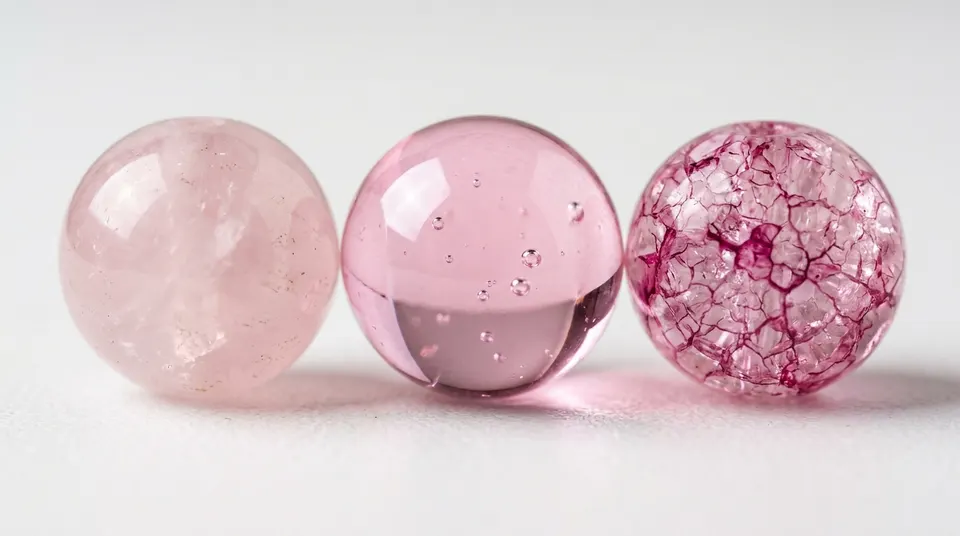
Natural rose quartz is usually cloudy and translucent, with a soft, fairly even pink. Pink glass often shows round gas bubbles, swirl lines or shell-shaped chips, and it is softer (about 5.5 on the Mohs scale versus 7). Dyed quartz is clear quartz that was heat-cracked and dyed, so under a 10x loupe the pink sits in a web of fine cracks. These signs suggest an answer; a gem lab confirms it.
On this page
Key Takeaways
- Natural rose quartz is quartz (Mohs 7) colored by microscopic mineral fibers, which is why it usually looks cloudy and translucent rather than glass-clear.
- Pink glass often shows round gas bubbles, swirl-like flow lines and shell-shaped chips at the edges; window glass sits around 5.5 on the Mohs scale.
- Dyed quartz is usually quench-crackled: heated, plunged into water to crack it, then dyed, so the pink collects in an evenly spaced web of fine cracks.
- US FTC guides say imitations must be labeled with a word such as "simulated", and treatments that are not permanent must be disclosed.
- A 10x loupe can point you in the right direction, but only a gem lab can confirm what a stone is. Never scratch-test jewelry.
What Does Real Rose Quartz Look Like?
Rose quartz is the pink variety of the mineral quartz (silicon dioxide, SiO2). GIA lists it with a Mohs hardness of 7, a refractive index of 1.544 to 1.553 and a specific gravity of about 2.66, and notes that microscopic mineral inclusions give it a cloudy translucence [1]. Those numbers are the same as for other quartz, including clear quartz, which matters later when we get to dyed quartz.
The cloudiness is a feature, not a flaw. GIA explains that rose quartz owes its pink color to microscopic inclusions of aligned silicate mineral fibers, similar but not identical to the mineral dumortierite. Those fibers likely crystallized as the quartz cooled, and they are spread through the stone [2]. Because the color comes from fibers scattered through the whole stone, rose quartz typically has:
- A soft, even pink. GIA describes a range from nearly white to medium-dark pink.
- A milky or hazy look. GIA says the cloudy translucence is why rose quartz is generally cut into beads and cabochons rather than faceted.
- Better color in bigger pieces. GIA notes that the most appealing color usually appears in larger sizes and that small stones with good color are rare [2].
- Sometimes a six-rayed star. A correctly oriented cabochon can show asterism, a star that moves as you tilt the stone.
That third point is a useful reality check. A strand of small 0.24 in (6 mm) beads that are all intensely saturated and glass-clear is not what GIA describes for typical rose quartz. It does not prove the beads are fake, but it is a reason to look closer.
GIA also describes a much rarer material, transparent "pink quartz" or "crystalline rose quartz", which gets its color by a different mechanism. Material from some deposits fades in natural light, and its color can be restored by irradiation; synthetic pink quartz is also grown with aluminum and phosphorus impurities and then irradiated [2]. Our guide to crystals that fade in sunlight covers display and storage, and the rose quartz profile collects the basics in one place. GIA lists Brazil as the source of the finest rose quartz rough, with India, Madagascar and Sri Lanka also producing it.
How Do Rose Quartz, Pink Glass and Dyed Quartz Compare?
The three materials differ most in where the color sits. In rose quartz it is spread through the stone by fibers; in glass it is mixed into the melt; in dyed quartz it is pushed into cracks.
| Feature | Natural rose quartz | Pink glass | Dyed (quench-crackled) quartz |
|---|---|---|---|
| What it is | Natural quartz colored by mineral fibers | Man-made, non-crystalline material | Natural quartz, cracked and dyed |
| Mohs hardness | 7 | About 5.5 (window glass) | 7 (still quartz) |
| Typical look | Cloudy, soft, fairly even pink | Any shade; clear, milky or frosted | Bright pink, often with visible crackle |
| Under a 10x loupe | Even haze through the stone | Round gas bubbles, swirl or flow lines | Pink concentrated in a web of fine cracks |
| Edges and chips | Granular to glassy breaks | Smooth, shell-shaped (conchoidal) chips | Crack lines reach the surface |
| Seller must disclose | Nothing extra if untreated | Must be qualified ("simulated", "glass") | The dye treatment |
Hardness values: GIA for quartz, CUNY Queensborough for window glass. Disclosure: FTC Jewelry Guides, 16 CFR 23.24-23.25.
How Can You Tell Pink Glass From Rose Quartz?
Glass is man-made and has no crystal structure, so it can be made in any shade of pink, molded into any shape and made very clear or deliberately milky. The signs that give it away come from how it is made: trapped air, the flow of the melt and the way it breaks.
GIA's laboratory described these features in glass made to imitate star sapphire: gas bubbles near the surface, small conchoidal (shell-shaped) fractures along the edges and flow lines inside, with a "star" that was simply molded into shape and fixed in place rather than moving with the light [3]. The same clues apply to pink glass beads:
- Round gas bubbles. Look with a 10x loupe, or a phone macro lens, near the drill hole and just under the surface. Perfectly round bubbles, alone or in strings, point toward glass.
- Swirl or flow lines. Curved streaks, like stirred syrup, show where the molten glass moved.
- Shell-shaped chips. Glass breaks with smooth, curved, scalloped chips, often at the edge of a drill hole.
- A molded look. A "star" that stays still when you tilt the bead, or shapes with soft, rounded seams, are signs of a molded product.
- Color that is too perfect. A clear, bright, identical pink across every bead in a strand does not match GIA's description of rose quartz as cloudy, with good color rare in small sizes.
Lab numbers make the difference clear. The glass imitation in that GIA case had a refractive index of 1.40 and a specific gravity of about 2.46, while GIA lists rose quartz at 1.544-1.553 and about 2.66 [1]. Glass recipes vary, so other glass will measure differently, but a gemologist with a refractometer can usually separate the two quickly.
Hardness also differs. A gemology course page at CUNY Queensborough lists window glass at 5.5 and quartz at 7 on the Mohs scale [5]. That is why glass beads tend to collect scuffs and dull edges faster in daily wear. The same page warns that cut stones can be seriously damaged by testing and that people should not test gems until they have a lot of practice on common minerals. Do not scratch a bracelet, a pendant or a seller's stone to find out what it is. Our Mohs hardness guide explains what the scale does and does not tell you.
"Cold to the touch" tests are popular but weak: both glass and quartz feel cool at first, and room temperature, bead size and how long you have held it all change the result. Treat it as a hint at most.
How Do You Spot Dyed Quartz?
Dyed quartz is real quartz with artificial color. The usual route is quench-crackling. GIA describes the process: a heated stone is plunged into room-temperature water, which creates fractures that let dye penetrate and change the color. GIA adds that this treatment is typically applied to quartz, cubic zirconia, glass and other synthetics because they are inexpensive and widely available [4].
Because the dye can only sit where the cracks are, the color pattern is the giveaway. GIA identified the treatment by dye concentrated along shallow, weblike fractures with uniform spacing and depth, a pattern that differs from natural fractures (same source). In a pink bead, that looks like:
- A crackle or "crazed ice" pattern of fine pink lines.
- Clearer, paler areas between the lines, instead of rose quartz's even haze.
- Darker color at the drill hole and in surface pits, where dye has more room to collect.
- A bright, candy-like pink that is more saturated than typical rose quartz.
Two cautions. First, hardness will not help here: dyed quartz is still quartz at Mohs 7, just like rose quartz. Second, glass can be crackled and dyed too, so a crackle pattern tells you the color was added but not, on its own, which base material was used. Our guide to spotting dyed crystals covers the same signs in other stones.
Dyed stones may also need gentler care. A cautious approach is mild soap and lukewarm water, a soft cloth and no solvents or long soaks; see how to clean crystal jewelry and the care chart for stone-by-stone notes.
What Must a Seller Disclose About Pink “Quartz”?
In the US, the Federal Trade Commission's Jewelry Guides set the rules. They are guides rather than statutes, but they describe what the FTC considers unfair or deceptive. Two sections matter most for pink beads:
- Imitations need a qualifier. Under 16 CFR 23.25, using an unqualified stone name for a product that is not a mined stone of that type is unfair or deceptive. A simulated or imitation stone should carry a word such as "simulated" immediately before the stone name, with equal conspicuousness, and the word "faux" alone is not an adequate disclosure [7]. Pink glass sold simply as "rose quartz" does not meet that standard.
- Some treatments must be disclosed. Under 16 CFR 23.24, a seller should disclose a gemstone treatment when it is not permanent (or may not be), when it creates special care requirements, or when it significantly affects value. For online sales, the disclosure belongs in the product description [6].
In practice, read the full listing, not just the title, and look for "dyed", "treated", "simulated", "glass" or "man-made". If it is unclear, ask the seller in writing: "Is this natural, untreated rose quartz?" A clear written answer is useful if you later need a return. Readers in Europe and the UK should check their own national consumer rules, which differ from the FTC guides.
When Do You Need a Gem Lab?
A loupe and a careful look can sort many bracelets into "probably rose quartz", "probably glass" and "probably dyed". They cannot prove it. Some glass contains few bubbles, some dyed stones are skillfully done, and natural rose quartz can contain fractures of its own.
A gem lab settles the question with measurements rather than impressions: refractive index and specific gravity (which separated glass from quartz in the GIA case above), magnification of the inclusions and, when needed, spectroscopy. In the quench-crackled sapphire case, GIA used the spacing and depth of the dyed fractures to tell the treatment apart from natural cracking [4]. A lab report is worth considering for a costly carving, a large sphere or an heirloom piece, or when a seller's claim and what you see do not match. For an inexpensive bead bracelet, a clear written disclosure from the seller is usually the practical answer.
The same approach works for purple quartz; see how to tell if amethyst is real. If you are choosing a new pink bracelet or pendant, the jewelry finder helps you match stone, style and daily wear.
Useful for this guide
Handmade Natural Gemstone Round Bead Stretch Bracelet
Check price on AmazonNatural Stone 8mm Beaded Bracelets, Set of 16
Check price on AmazonGem Semi Precious Gemstone 8mm Round Beads Stretch Bracelet 7 Inch Unisex
Check price on Amazon
Frequently Asked Questions
Is cloudy rose quartz real?
Cloudiness is normal for rose quartz. GIA explains that its pink comes from microscopic mineral fibers that also give it a cloudy translucence, which is why it is usually cut into beads and cabochons. Cloudiness alone does not prove a stone is natural, though, because glass can be made milky too.
Can rose quartz be completely clear?
Rarely. GIA describes a transparent pink quartz that is far rarer than ordinary rose quartz and colored by a different mechanism; some of it fades in natural light. Synthetic pink quartz also exists. A strand of perfectly clear, bright pink small beads is more likely to be glass or dyed than ordinary rose quartz.
Does dyed quartz lose its color?
It can be hard to predict, which is one reason the FTC guides say a seller should disclose a treatment that is not, or may not be, permanent, or that needs special care. As a precaution, clean dyed beads with mild soap and water only, avoid solvents and long soaks, and store them out of strong light.
Is the "rose quartz" on an inexpensive bracelet real?
It can be, since rose quartz is not a rare stone. Check the full listing for words such as "dyed", "treated", "simulated" or "glass", look for bubbles, swirl lines and dye-filled cracks under a loupe, and ask the seller in writing if the description is vague.
Does rose quartz scratch easily?
Rose quartz is Mohs 7, harder than window glass at about 5.5, so it holds up reasonably well in daily wear. Harder stones can still scratch it, and rubbing beads against each other dulls them over time, so store pieces separately.
Our Take
We think the most useful habit is to look at where the color sits. Rose quartz is pink all the way through and a little hazy; glass gives itself away with bubbles and swirls; dyed quartz carries its color in a web of cracks. In our view, none of these materials is "bad" in itself: glass and dyed quartz can make attractive, inexpensive jewelry. The problem is being sold one as another. We would favor sellers who state the material and any treatment plainly in the listing, and we would not rely on scratch or touch tests to decide. When the answer really matters, a gem lab report is the only firm one.
Sources
- Rose Quartz. GIA.
- Rose Quartz Description. GIA.
- Lab Notes: Glass Imitation Star Sapphire. GIA Gems & Gemology, 2021.
- Quench-Crackled and Dyed Laboratory-Grown Sapphire. GIA Gems & Gemology, 2025.
- Hardness of Minerals. CUNY Queensborough Community College.
- 16 CFR 23.24 - Disclosure of treatments to gemstones. Cornell Law School LII.
- 16 CFR 23.25 - Misuse of the words ruby, sapphire, emerald, topaz, stone, birthstone, gem, gemstone, etc. Cornell Law School LII.
Crystal Field Guide covers mineralogy, identification and care. We make no claims that any stone affects health, mood or fortune. Home checks can only suggest an answer; for certainty about a valuable stone, ask an accredited gem lab. Spotted an error? Tell us.
More Crystal Guides
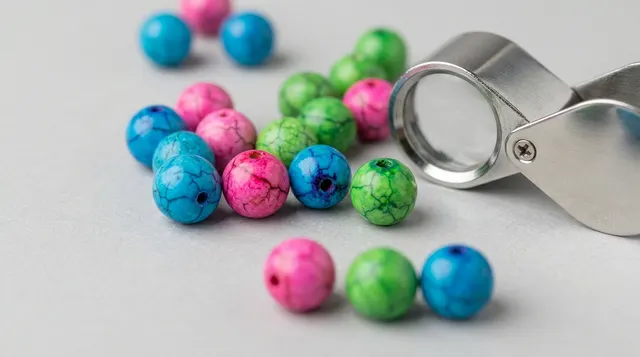
How to Spot Dyed Crystals and Stones
How to spot dyed crystals: color pooled in cracks and drill holes, hues not found in nature, howlite sold as turquoise, and when you need a gem lab to be sure.
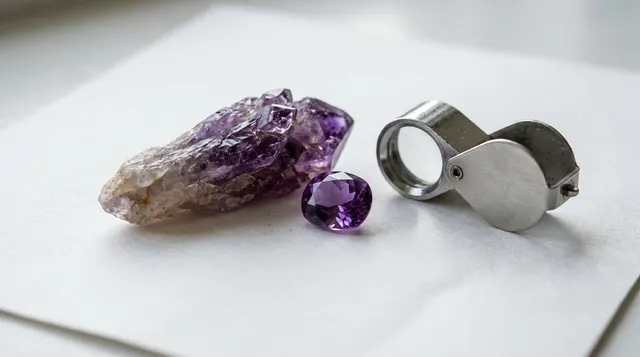
How to Tell If Amethyst Is Real: Natural, Synthetic and Glass
How to tell real amethyst from synthetic quartz and glass: color zoning, bubbles, refractive index, heat treatment, and when only a gem lab can be sure.
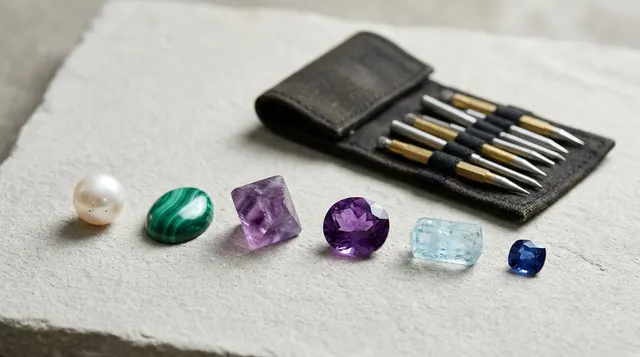
Mohs Hardness for Crystal Jewelry: Which Stones Scratch Easily?
Mohs hardness for crystal jewelry: which stones scratch easily, why 7 is the everyday-wear line, and how to match soft stones to rings, pendants and earrings.
Crystal Bead Bracelet Size Guide: Wrist Size and Bead mm
How to measure your wrist, how much length to add for 4 to 12 mm beads, how many beads a bracelet needs, and how bead size changes weight and fit.
How to Clean Crystal Jewelry Without Damaging It
Clean crystal jewelry with warm water, mild soap and a soft brush. Which stones must skip ultrasonic, steam and chemical cleaners, and why GIA says so.
How to Store Crystal Jewelry and Stones Without Scratches
Store crystal jewelry by hardness: a pouch or slot per piece, soft stones and pearls kept apart, away from strong light, heat and plastic bags. Stone by stone.