How to Tell If Amethyst Is Real: Natural, Synthetic and Glass
Quick Answer
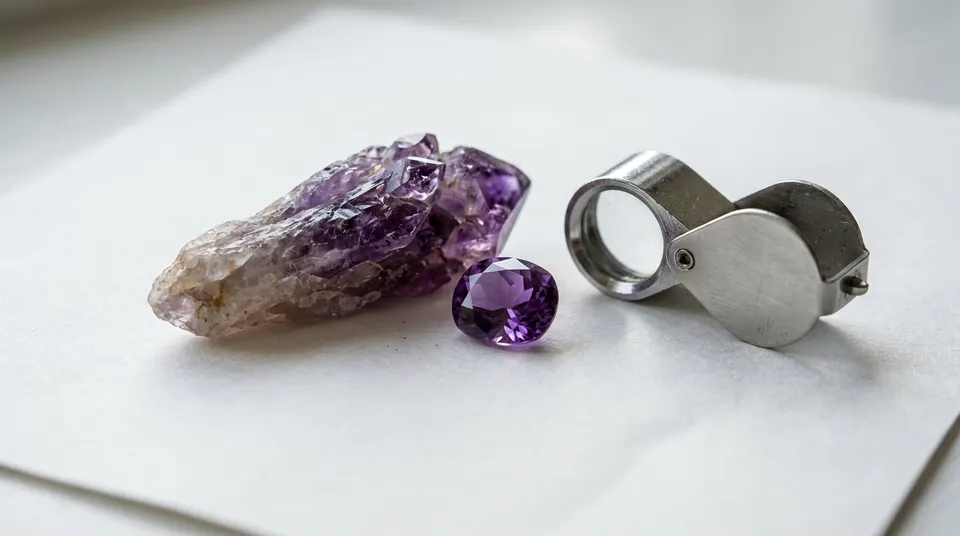
To tell if amethyst is real, look at it table-down on white paper with a loupe. Natural amethyst usually shows angular bands of darker and lighter purple and may contain small natural inclusions. Round gas bubbles and swirls suggest glass. Synthetic amethyst is chemically the same quartz, so no home test separates it reliably; only a gem lab using a polariscope and infrared spectroscopy can confirm natural origin.
On this page
- What Are You Actually Looking At: Natural, Synthetic or Glass?
- What Does Natural Amethyst Look Like Under a Loupe?
- How Can You Spot Glass Amethyst at Home?
- Can You Tell Synthetic Amethyst From Natural Without a Lab?
- Is Heat-Treated or Dyed Amethyst Still Real Amethyst?
- When Should You Send Amethyst to a Gem Lab?
- Frequently Asked Questions
- Our Take
- Sources
Key Takeaways
- Natural amethyst is purple quartz, about 7 on the Mohs scale, and usually shows angular zones of lighter and darker purple.
- Round gas bubbles and perfectly even color point toward glass; glass also has a lower refractive index and specific gravity than quartz.
- Synthetic amethyst has essentially the same physical and optical properties as natural amethyst, so home tests cannot rule it out.
- Heat treatment is common and permanent, and it still leaves a natural amethyst; dyed quartz and glass are different products.
- For a firm answer on a valuable piece, a gem lab uses magnification, a polariscope and infrared spectroscopy together.
What Are You Actually Looking At: Natural, Synthetic or Glass?
Start by naming the possibilities, because each one needs a different check. GIA defines amethyst as "the purple variety of the quartz mineral species" [2]. That gives a natural stone three properties you can lean on: a Mohs hardness of 7, a refractive index of 1.544 to 1.553 and a specific gravity of 2.66 [1].
Synthetic amethyst is not fake in the chemical sense. GIA describes synthetics as gems grown in a laboratory with essentially the same chemical, physical and optical properties as their natural counterparts [1], and notes that synthetic amethyst has been known since the 1970s [4]. An imitation is a different material that only looks like amethyst, most often glass.
| What it is | Material | Hardness and optics | Typical tell-tale signs | Can you confirm it at home? |
|---|---|---|---|---|
| Natural amethyst | Quartz (SiO2) | Mohs 7; RI 1.544-1.553; SG 2.66 | Angular color zones; small natural inclusions; many faceted stones are eye-clean | Partly: features suggest natural, but do not prove it |
| Heat-treated amethyst | Natural quartz, heated | Same as natural | Often lighter, even color; heating is permanent | No: usually not visible |
| Synthetic amethyst | Lab-grown quartz | Essentially the same as natural | May look very clean; zoning can differ from natural | No: needs a lab |
| Glass imitation | Silicate glass | Lower RI and SG than quartz (one GIA glass study: RI 1.48, SG 2.48-2.57) | Round gas bubbles, swirl lines, very even color | Often suggested, sometimes clear |
| Dyed quartz | Pale quartz with added color | Same as quartz | Color concentrated in cracks or drill holes | Sometimes |
The glass figures come from one GIA study of a glass imitation, where gemologists measured a spot refractive index of 1.48 and a specific gravity of about 2.48 to 2.57 [7]. Glass recipes vary, so treat those numbers as an example of "lower than quartz", not as a rule for every purple glass. Our amethyst profile covers the stone's basics, and the clear quartz profile explains the mineral family it belongs to.
What Does Natural Amethyst Look Like Under a Loupe?
The most useful home clue is color zoning. GIA notes that amethyst "usually shows angular zones of darker and lighter color" [2]. Those zones follow the crystal's growth faces, so in natural material they tend to run in straight bands that meet at angles, rather than in soft swirls.
How to look:
- Use white paper and daylight-type light. GIA says zoning is most visible when a stone is viewed face-down through its pavilion on a white background [3]. Face-up, the facets scatter light and hide the bands.
- Tilt slowly. Look for straight lighter and darker stripes that meet at angles. In a round bead of 8 mm (about 5/16 inch), they may show as patchy areas rather than clean lines.
- Check the inclusions. GIA notes most faceted amethyst is eye-clean, while material from Zambia tends to be a saturated raspberry color with more inclusions than Brazilian stones; stones with visible inclusions but good color often become cabochons or beads [3].
Even, featureless color is not proof of a fake, and visible zoning is not proof of a natural stone. High-grade natural amethyst is prized precisely because it shows little visible zoning, and GIA notes that the finest color has "no visible color zoning" [1]. A loupe narrows the options; it does not close the case.
How Can You Spot Glass Amethyst at Home?
Glass is the imitation that home checks catch most often, because it differs from quartz in several ways you can see.
- Round gas bubbles. In the GIA glass study above, the examiners saw numerous gas bubbles of different sizes and called gas bubble inclusions the diagnostic feature [7]. Perfectly round bubbles inside a purple stone are one of the strongest home signs of glass. Natural quartz has inclusions too, but they are usually irregular crystals, fluid pockets or feathers, not clean spheres.
- Swirls and flow lines. Molten glass can leave curved lines as it cools. Quartz grows in straight layers.
- Color that is too perfect. Strong, completely even purple across a whole strand of beads is possible in natural material, but it is common in glass.
- Temperature. Quartz often feels cool to the touch for longer than glass. This is a weak hint only: room temperature, stone size and your own hands change the result.
- Context. A large strand of flawless deep purple beads sold as inexpensive "genuine amethyst" deserves a closer look.
What you should not do is scratch the stone. Quartz is 7 on the Mohs scale [4], and a scratch test on finished jewelry, or on a stone you do not own, can leave permanent damage while proving little. If you want to compare hardness, our care chart lists Mohs values side by side for planning wear and storage, not for testing.
Professionals separate glass from quartz with a refractometer: quartz reads 1.544 to 1.553, and glass typically reads differently, often lower. That instrument reading, not a bubble alone, is what turns a suspicion into an identification.
Can You Tell Synthetic Amethyst From Natural Without a Lab?
In most cases, no. Synthetic amethyst is quartz, so its hardness, refractive index and density match the natural stone closely. The checks that catch glass do not work.
Gemologists rely on internal growth features. A 1986 Gems & Gemology paper by Robert Crowningshield, Cornelius Hurlbut and C. W. Fryer explained that most natural amethyst shows a type of twinning called Brazil twinning, that the synthetic stones they examined showed twinning in a distinctly different form, and that "a standard gemological polariscope is more than adequate to make the separation in most cases" [5]. The same authors said inclusions and the nature of the color zoning are of primary use in the separation.
Later research shows the limits. A 2004 Gems & Gemology study by Vladimir Balitsky and colleagues found "no unambiguous diagnostic features" in the infrared spectra of the more commercially significant synthetic amethyst, and concluded that identification must rest on a combined examination of infrared spectra, internal growth structures including twinning, and inclusions [6]. An infrared absorption band at 3543 cm-1 appears in most synthetic amethyst grown in alkaline solutions, but it is sometimes present in natural amethyst too, so it is only tentative evidence.
If a home test seems to prove a stone is natural rather than synthetic, the test is claiming more than it can. The honest home result is "consistent with natural or synthetic quartz." That is often enough for an inexpensive bead bracelet. It is not enough for an heirloom ring or a costly loose stone.
Is Heat-Treated or Dyed Amethyst Still Real Amethyst?
Heat-treated amethyst is still natural amethyst. GIA calls heat treatment "the most common technique for improving the color and marketability of natural amethyst," says it produces a permanent change in color, and notes that some amethyst turns yellow, to citrine, when heated [4]. Heating can also lighten very dark amethyst [3]. That is why much yellow quartz on the market began as amethyst; see our citrine profile.
Dyed material is different. GIA notes that some light amethyst and light quartz is dyed to add a purple color, and that amethyst rarely receives fracture filling in surface-reaching cracks [3]. Under a loupe, dye tends to collect in cracks and around drill holes in beads, leaving darker lines where color has pooled.
Disclosure matters here. The US Federal Trade Commission's jewelry guidance tells sellers to disclose a treatment if it is not permanent or if it significantly affects a gemstone's value, to disclose special care needs, and to label imitation stones with words such as "imitation" or "simulated" right before the stone name [8]. It also warns against the word "faux" for laboratory-created or imitation stones. Asking a seller "Is this natural, synthetic or glass, and is it treated?" is a fair question, and a clear written answer is worth keeping.
Two care facts follow from treatment and composition. GIA says some amethyst fades with prolonged exposure to strong light, that excessive heat can remove the color entirely, and that steam cleaning is not recommended, while a soft brush with mild soap is the safest option [4]. Store amethyst out of strong sun and away from heat.
When Should You Send Amethyst to a Gem Lab?
A lab report makes sense when the answer changes what you do: you are paying a lot, insuring a piece, selling it, or settling an inheritance. A lab can combine magnification, a polariscope to look for twinning, a refractometer and infrared spectroscopy, the same combined approach the Gems & Gemology research above calls for.
Before you send a stone, write down what the seller said, keep the receipt, and photograph the piece. Choose an independent laboratory that issues written reports, such as GIA, rather than relying on a seller's own certificate. If you are choosing jewelry rather than investigating a stone you already own, our jewelry finder helps match stone, style and daily wear, and the shop lists jewelry and tools such as loupes.
Useful for this guide
Loupes 10x Glass Jeweler Loupe Loop Eye Magnifier Magnifying Magnifier Metal Body Silver
Check price on AmazonJewelers Loupe Magnifier 10X Triplet Loupe
Check price on Amazon3 Pcs Jewelers Loupe Eye 10X 20X 30X Hand Lens Set,Silver,Triplet Style
Check price on Amazon
Frequently Asked Questions
Does real amethyst have bubbles?
Natural amethyst can contain inclusions, but perfectly round gas bubbles are typical of glass. GIA examiners have called gas bubble inclusions the diagnostic feature of a glass imitation. Natural quartz inclusions are usually irregular: tiny crystals, fluid pockets or feather-like cracks. One round bubble is a strong hint, and a refractometer reading confirms it.
Is synthetic amethyst fake?
Not in the chemical sense. Synthetic amethyst is laboratory-grown quartz with essentially the same physical and optical properties as natural amethyst. It is not natural, though, and sellers should disclose that. GIA notes synthetic amethyst has been known since the 1970s, and telling it apart from natural usually takes advanced lab testing.
Can I test amethyst with a scratch test?
Please don't. A scratch test can permanently mark a stone, and on finished jewelry or a seller's stock it is damage, not testing. Quartz is 7 on the Mohs scale, so a result tells you only that the material is hard, not whether it is natural, synthetic or another hard material. A loupe and a lab are the safe routes.
Why does my amethyst look lighter than it used to?
GIA notes that some amethyst fades with prolonged exposure to strong light, and that excessive heat can remove the color entirely. A pendant left in a sunny window or a stone exposed to high heat can lose depth of color. Store amethyst away from direct sun and heat sources.
Is heat-treated amethyst worth less?
Heat treatment is the most common treatment for amethyst and produces a permanent color change, so it is widely accepted. Whether it affects value depends on the stone and the market. The FTC tells sellers to disclose any treatment that significantly affects value, so asking about treatment is reasonable.
Our Take
We think the most useful mindset is to separate two questions. "Is this glass?" is often answerable at home with a loupe, white paper and patience. "Is this natural or lab-grown?" usually is not, and in our view any shortcut that claims otherwise should be treated with suspicion. For an inexpensive bead bracelet, we would focus on avoiding glass and dyed quartz and ask for a clear written description. For an heirloom, an engagement piece or anything costly, we would pay for an independent lab report before money changes hands. Honest disclosure from a seller is worth more than any home trick.
Sources
- Amethyst. GIA.
- Amethyst Description. GIA.
- Amethyst Quality Factors. GIA.
- February Birthstone: Amethyst. GIA.
- A Simple Procedure to Separate Natural from Synthetic Amethyst on the Basis of Twinning. GIA Gems & Gemology, 1986.
- The 3543 cm-1 Infrared Absorption Band in Natural and Synthetic Amethyst and Its Value in Identification. GIA Gems & Gemology, 2004.
- Greenish Blue Glass Imitating Gem Silica. GIA Gems & Gemology, 2020.
- In the Loupe: Advertising Diamond, Gemstones and Pearls. FTC.
Crystal Field Guide covers mineralogy, identification and care. We make no claims that any stone affects health, mood or fortune. Home checks can only suggest an answer; for certainty about a valuable stone, ask an accredited gem lab. Spotted an error? Tell us.
More Crystal Guides
Is Your Citrine Real? Natural Citrine vs Heat-Treated Amethyst
How to tell natural citrine from heat-treated amethyst: color, zoning, dichroism and what a gem lab checks, plus why most citrine on the market is heated.
How to Spot Dyed Crystals and Stones
How to spot dyed crystals: color pooled in cracks and drill holes, hues not found in nature, howlite sold as turquoise, and when you need a gem lab to be sure.
Mohs Hardness for Crystal Jewelry: Which Stones Scratch Easily?
Mohs hardness for crystal jewelry: which stones scratch easily, why 7 is the everyday-wear line, and how to match soft stones to rings, pendants and earrings.
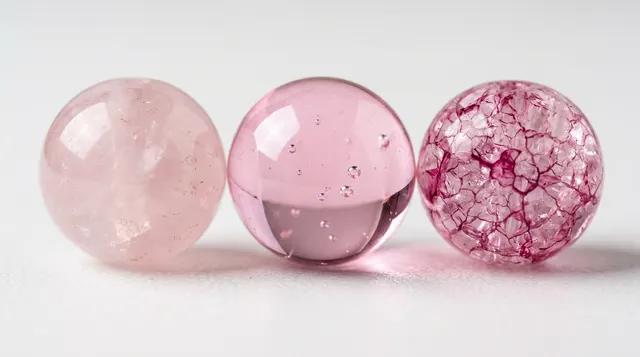
Rose Quartz vs Pink Glass vs Dyed Quartz: How to Tell
How to tell natural rose quartz from pink glass and dyed quartz: color, clarity, gas bubbles, dye-filled cracks, hardness, FTC disclosure rules and lab tests.
How to Store Crystal Jewelry and Stones Without Scratches
Store crystal jewelry by hardness: a pouch or slot per piece, soft stones and pearls kept apart, away from strong light, heat and plastic bags. Stone by stone.
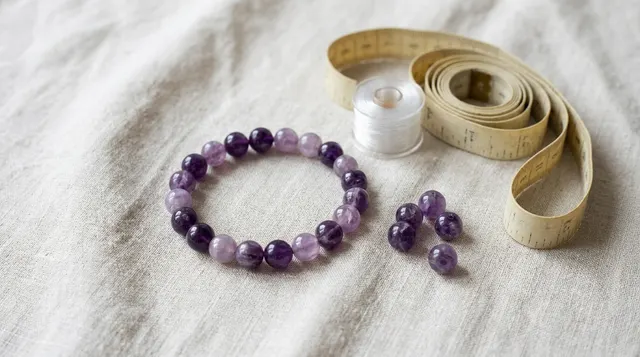
Crystal Bead Bracelet Size Guide: Wrist Size and Bead mm
How to measure your wrist, how much length to add for 4 to 12 mm beads, how many beads a bracelet needs, and how bead size changes weight and fit.